Predict the products of the following SN2 reactions. (a) (b)
Verified step by step guidance
1
Step 1: Understand the SN2 reaction mechanism. SN2 reactions involve a single-step nucleophilic substitution where the nucleophile attacks the electrophilic carbon and simultaneously displaces the leaving group. This reaction is favored by primary or secondary alkyl halides and strong nucleophiles.
Step 2: Analyze reaction (a). CH3CH2ONa is a strong nucleophile (ethoxide ion), and CH3CH2Cl is a primary alkyl halide. The ethoxide ion will attack the electrophilic carbon in CH3CH2Cl, displacing the chloride ion (Cl⁻) as the leaving group. The product will be an ether formed via nucleophilic substitution.
Step 3: Analyze reaction (b). The molecule CH2CH2Br attached to a benzene ring is a primary alkyl bromide. NaCN provides the cyanide ion (CN⁻), which is a strong nucleophile. The cyanide ion will attack the electrophilic carbon bonded to the bromine atom, displacing the bromide ion (Br⁻) as the leaving group. The product will be a nitrile group (-CN) attached to the benzyl group.
Step 4: Consider stereochemistry. SN2 reactions proceed with inversion of configuration at the electrophilic carbon. However, in these cases, the electrophilic carbons are not chiral, so stereochemistry is not a concern.
Step 5: Write the general products. For reaction (a), the product is CH3CH2OCH2CH3 (an ether). For reaction (b), the product is benzyl cyanide (C6H5CH2CH2CN). These products are formed via the SN2 mechanism.
Verified video answer for a similar problem:
This video solution was recommended by our tutors as helpful for the problem above
Video duration:
6m
Play a video:
0 Comments
Key Concepts
Here are the essential concepts you must grasp in order to answer the question correctly.
S<sub>N</sub>2 Mechanism
The S<sub>N</sub>2 mechanism is a type of nucleophilic substitution reaction where a nucleophile attacks an electrophile, resulting in the simultaneous displacement of a leaving group. This reaction occurs in a single concerted step, leading to the formation of a product with inversion of configuration at the carbon center. Understanding this mechanism is crucial for predicting the products of reactions involving primary and secondary alkyl halides.
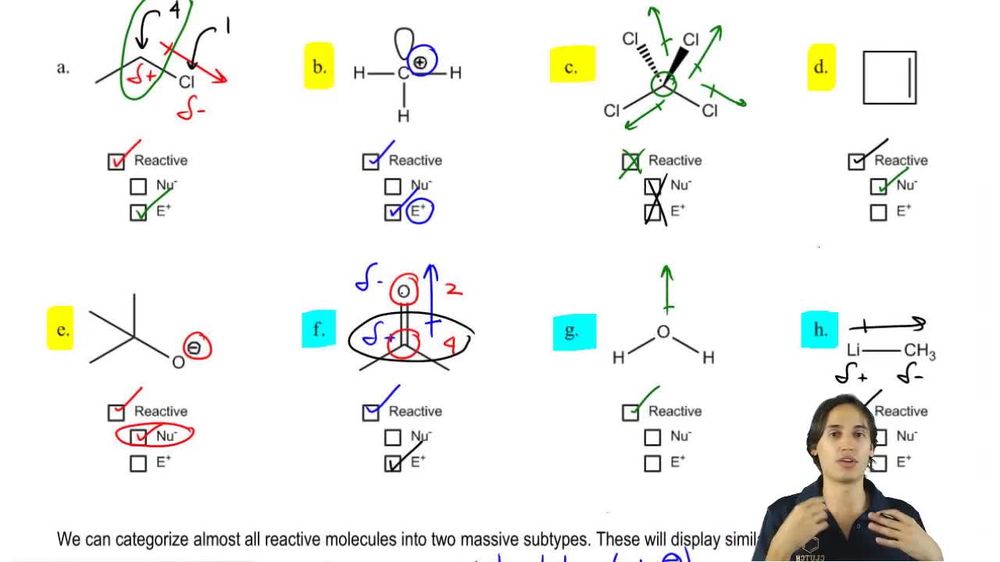
Nucleophiles are species that donate an electron pair to form a chemical bond, while electrophiles are electron-deficient species that accept electron pairs. In S<sub>N</sub>2 reactions, the nucleophile attacks the electrophile, which is typically a carbon atom bonded to a leaving group. Identifying the nucleophile and electrophile in a reaction is essential for predicting the outcome and products of the reaction.
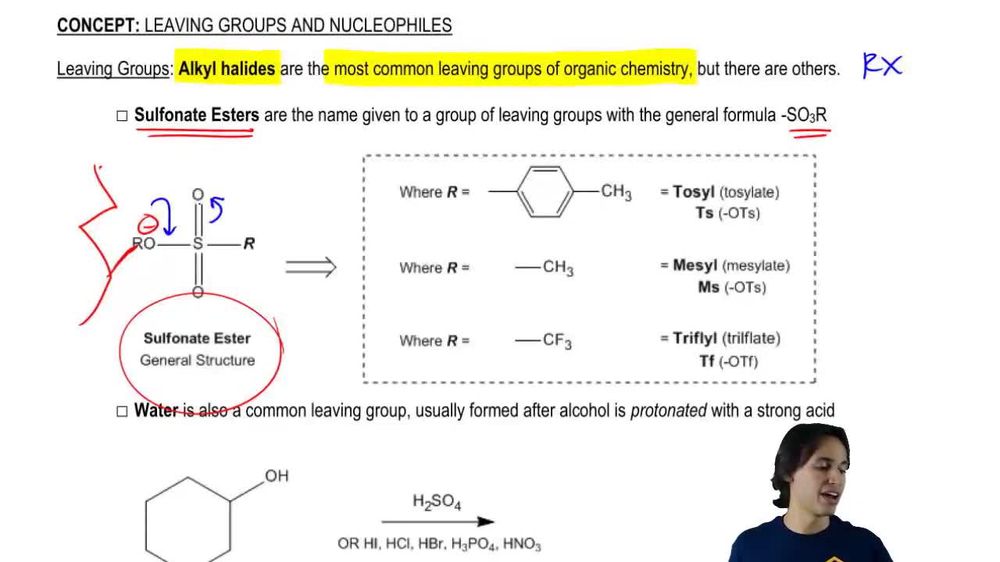
Leaving groups are atoms or groups that can depart from the parent molecule during a chemical reaction, allowing for the formation of new bonds. In S<sub>N</sub>2 reactions, good leaving groups are typically weak bases that can stabilize the negative charge after departure. Common leaving groups include halides and sulfonate esters. Recognizing the nature of the leaving group is vital for understanding the reactivity and product formation in nucleophilic substitution reactions.

 6:19 minutes

 Verified step by step guidance
 05:29
05:29