Predict the major products of the following substitutions. d. CH3CH2CH2I + NaCN →
Verified step by step guidance
1
Identify the type of substitution reaction: The reaction involves CH3CH2CH2I (1-iodopropane) and NaCN (sodium cyanide). This is a nucleophilic substitution reaction, specifically SN2, because the substrate is a primary alkyl halide, which favors the SN2 mechanism.
Understand the mechanism: In an SN2 reaction, the nucleophile (CN⁻ from NaCN) attacks the electrophilic carbon (the carbon attached to the iodine atom) from the opposite side of the leaving group (I⁻). This results in a single-step, concerted mechanism with inversion of configuration at the carbon center.
Determine the nucleophile and leaving group: The nucleophile is CN⁻, which is a strong nucleophile, and the leaving group is I⁻, which is a good leaving group due to its large size and ability to stabilize the negative charge.
Predict the product: The CN⁻ nucleophile will replace the iodine atom in the substrate, forming a new carbon-carbon bond. The product will be CH3CH2CH2CN (butanenitrile), where the cyanide group (-CN) is attached to the terminal carbon of the original alkyl halide.
Verify the reaction conditions: Ensure that the reaction is carried out in a polar aprotic solvent (e.g., DMSO or acetone) to favor the SN2 mechanism and avoid side reactions.
Verified video answer for a similar problem:
This video solution was recommended by our tutors as helpful for the problem above
Video duration:
4m
Play a video:
0 Comments
Key Concepts
Here are the essential concepts you must grasp in order to answer the question correctly.
Nucleophilic Substitution
Nucleophilic substitution is a fundamental reaction in organic chemistry where a nucleophile replaces a leaving group in a molecule. In this case, NaCN acts as the nucleophile, attacking the carbon atom bonded to the iodine in CH3CH2CH2I. Understanding the mechanism, whether it follows an SN1 or SN2 pathway, is crucial for predicting the product.
Nucleophiles and Electrophiles can react in Substitution Reactions.
Leaving Groups
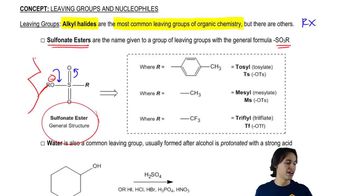
A leaving group is an atom or group that can depart from the parent molecule during a chemical reaction. In this reaction, iodine (I) is the leaving group, and its ability to leave is influenced by its bond strength and stability as an ion. A good leaving group enhances the likelihood of a successful nucleophilic substitution.
Stereochemistry refers to the spatial arrangement of atoms in molecules and how this affects their chemical behavior. In nucleophilic substitution reactions, the stereochemistry can change depending on whether the reaction proceeds via an SN1 or SN2 mechanism. This is important for predicting the configuration of the product, especially if the substrate is chiral.