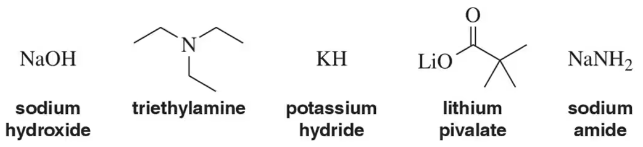
A medicinal chemist needed to deprotonate acetylene ( HC≡CH ) for use in a coupling reaction. Among the options given, which base(s) could be used for this process?
Verified step by step guidance
1
Step 1: Understand the acidity of acetylene (HC≡CH). Acetylene is a terminal alkyne, and its hydrogen atom attached to the sp-hybridized carbon is relatively acidic compared to other hydrocarbons. The pKa of acetylene is approximately 25, meaning it requires a strong base to deprotonate it effectively.
Step 2: Evaluate the strength of the bases provided. A base must have a conjugate acid with a pKa higher than 25 to deprotonate acetylene. Sodium hydroxide (NaOH) has a conjugate acid (water) with a pKa of 15.7, making it too weak. Triethylamine is an organic base with a conjugate acid (triethylammonium ion) pKa of around 10.7, also too weak.
Step 3: Consider potassium hydride (KH). KH is a strong base because it forms H2 gas upon reaction with an acid, and its conjugate acid (H2) has a pKa of approximately 35, making it suitable for deprotonating acetylene.
Step 4: Examine lithium pivalate. Lithium pivalate is a carboxylate salt, and its conjugate acid (pivalic acid) has a pKa of around 5, which is far too weak to deprotonate acetylene.
Step 5: Assess sodium amide (NaNH2). Sodium amide is a very strong base with a conjugate acid (ammonia) pKa of approximately 38, making it highly effective for deprotonating acetylene. Therefore, KH and NaNH2 are the bases that can be used for this process.
Verified video answer for a similar problem:
This video solution was recommended by our tutors as helpful for the problem above
Play a video:
0 Comments
Key Concepts
Here are the essential concepts you must grasp in order to answer the question correctly.
Acidity and Basicity
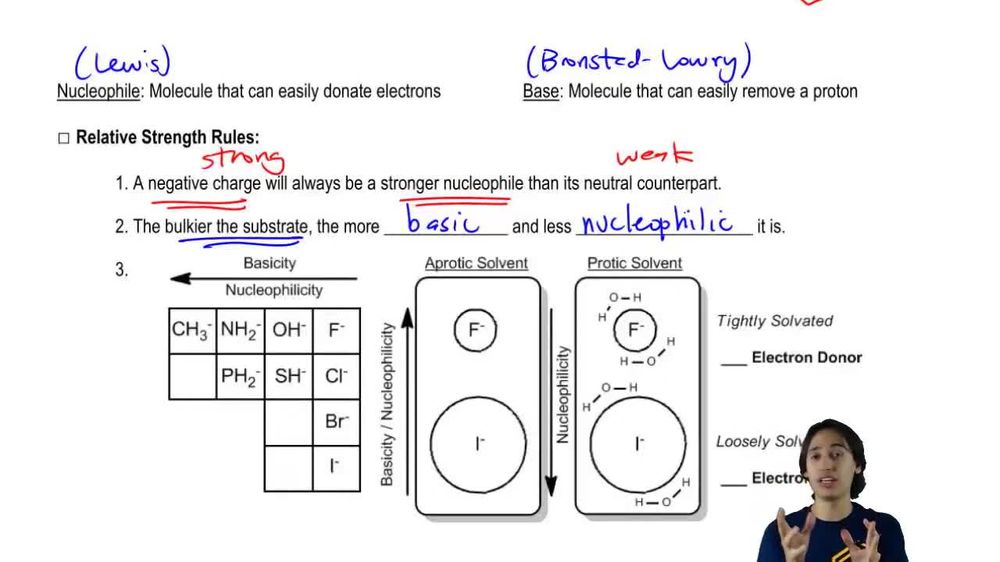
In organic chemistry, acidity refers to the tendency of a compound to donate protons (H+), while basicity refers to the ability to accept protons. Acetylene (HC≡CH) is a weak acid, and understanding its acidity is crucial for identifying suitable bases that can effectively deprotonate it. The strength of the base must be greater than the acidity of acetylene to achieve deprotonation.
Understanding the difference between basicity and nucleophilicity.
Deprotonation
Deprotonation is the removal of a proton from a molecule, resulting in the formation of a conjugate base. In the context of acetylene, deprotonation leads to the formation of the acetylide ion (HC≡C-), which is a strong nucleophile and can participate in various coupling reactions. Identifying the right base for this process is essential for successful reaction outcomes.
Strong bases are substances that can effectively deprotonate weak acids. Common strong bases used in organic chemistry include alkoxides, hydrides, and amides. For deprotonating acetylene, bases such as sodium amide (NaNH2) or lithium diisopropylamide (LDA) are often employed due to their high basicity, which allows them to remove protons from acetylene efficiently.