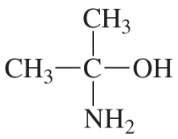
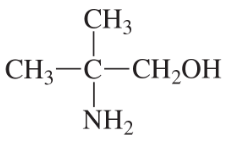
For each compound, indicate the atom that is most apt to be protonated. a. b. c.
Verified step by step guidance
1
Step 1: Analyze the functional groups in each compound. Protonation typically occurs at atoms with lone pairs of electrons, such as oxygen or nitrogen, because they can accept a proton (H⁺).
Step 2: For compound (a), identify the functional groups: it contains an -OH group (hydroxyl) and an -NH₂ group (amine). Both oxygen and nitrogen have lone pairs, but nitrogen is more basic and more likely to be protonated.
Step 3: For compound (b), identify the functional groups: it contains an -OH group attached to a tertiary carbon and an -NH₂ group. The nitrogen atom in the -NH₂ group is more basic than the oxygen atom in the -OH group, so nitrogen is the most likely site for protonation.
Step 4: For compound (c), identify the functional groups: it contains an -NH₂ group and a -CH₂OH group. The nitrogen atom in the -NH₂ group is more basic than the oxygen atom in the -CH₂OH group, making nitrogen the most likely site for protonation.
Step 5: Summarize the findings: In all three compounds, the nitrogen atom in the -NH₂ group is the most apt to be protonated due to its higher basicity compared to the oxygen atoms in the hydroxyl groups.
Verified video answer for a similar problem:
This video solution was recommended by our tutors as helpful for the problem above
Video duration:
5m
Play a video:
0 Comments
Key Concepts
Here are the essential concepts you must grasp in order to answer the question correctly.
Protonation
Protonation is the addition of a proton (H⁺) to a molecule, which can significantly alter its chemical properties. In organic chemistry, the site of protonation is often determined by the basicity of the atoms involved. Atoms with lone pairs of electrons, such as nitrogen or oxygen, are typically more likely to be protonated due to their ability to stabilize the positive charge that results from the addition of a proton.
Acidity and basicity are fundamental concepts in organic chemistry that describe the tendency of a substance to donate or accept protons, respectively. The strength of an acid is determined by its ability to donate protons, while a base is characterized by its ability to accept protons. Understanding the relative acidity and basicity of functional groups in a compound is crucial for predicting which atom is most likely to be protonated.
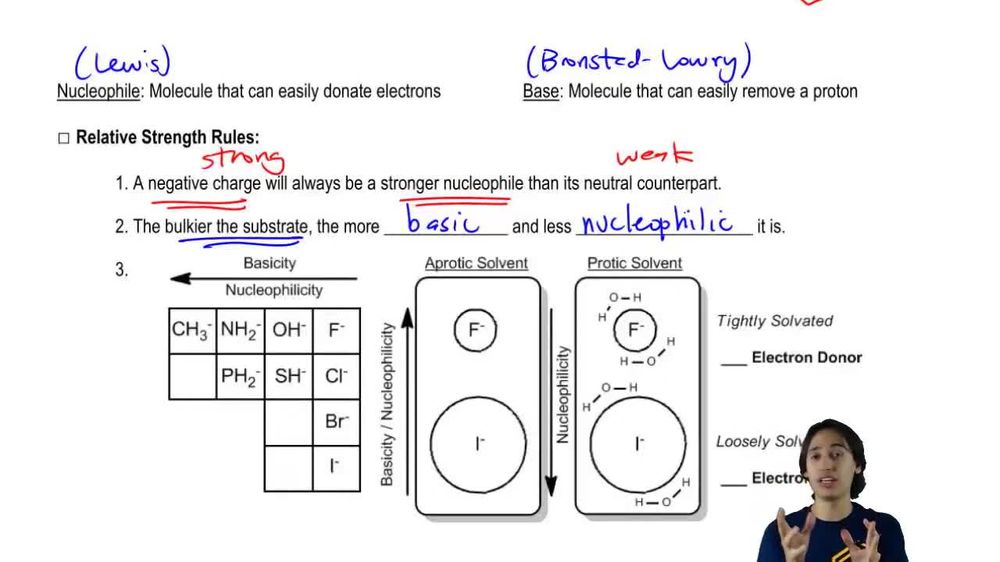
Understanding the difference between basicity and nucleophilicity.
Resonance Stabilization
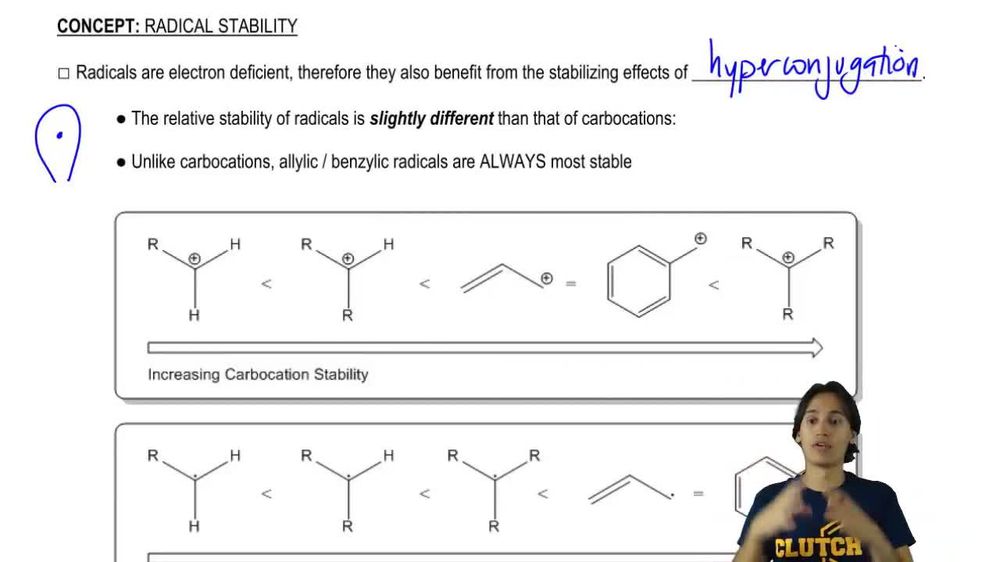
Resonance stabilization refers to the delocalization of electrons across multiple atoms in a molecule, which can enhance stability. When considering protonation, atoms that can participate in resonance often become more favorable sites for protonation because the resulting positive charge can be distributed over several atoms, reducing the energy of the protonated species. This concept is essential for predicting the most likely site of protonation in complex organic molecules.

 5:47 minutes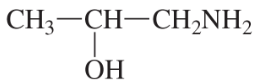
 Verified step by step guidance

 03:
03: