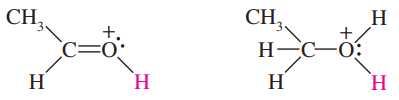
Like nitrogen and carbon, oxygen also shows this same hybridization effect on acidity. Both of the following compounds can lose a proton from a positively charged oxygen with three bonds to give a conjugate base containing a neutral oxygen with two bonds. One of these structures has pKa = −2.4, while the other has pKa = −8.0. a. Show the reaction of each compound with water. b. Match each structure with its pKa, and explain your choice.
Verified step by step guidance
1
Identify the two compounds: The first compound is a protonated acetone (CH3C(OH)CH3) and the second compound is a protonated ethanol (CH3CH2OH). Both have a positively charged oxygen with three bonds.
Write the reaction of each compound with water: For each compound, show the deprotonation process where the positively charged oxygen loses a proton (H+) to water, forming a hydronium ion (H3O+) and the neutral conjugate base.
For the first compound (protonated acetone), the reaction with water is: CH3C(OH)CH3 + H2O → CH3C(O)CH3 + H3O+. The conjugate base is acetone.
For the second compound (protonated ethanol), the reaction with water is: CH3CH2OH2+ + H2O → CH3CH2OH + H3O+. The conjugate base is ethanol.
Match each structure with its pKa: The compound with the more stable conjugate base (acetone) will have the lower pKa value. Acetone is more stable due to resonance stabilization, so it corresponds to the pKa of -8.0. The protonated ethanol, which lacks such stabilization, corresponds to the pKa of -2.4.
Verified video answer for a similar problem:
This video solution was recommended by our tutors as helpful for the problem above
Video duration:
10m
Play a video:
0 Comments
Key Concepts
Here are the essential concepts you must grasp in order to answer the question correctly.
Hybridization and Acidity
Hybridization affects the acidity of a molecule by influencing the stability of the conjugate base. In general, the more s-character in the hybrid orbital of the atom bearing the acidic hydrogen, the more acidic the compound. This is because s-orbitals are closer to the nucleus, stabilizing the negative charge on the conjugate base. In the given compounds, the hybridization of the oxygen atom plays a crucial role in determining their acidity.
The pKa value is a measure of the acidity of a compound, with lower pKa values indicating stronger acids. It represents the equilibrium constant for the dissociation of an acid into its conjugate base and a proton. In the context of the question, comparing the pKa values of the two compounds helps determine which is the stronger acid, as the compound with the lower pKa will more readily lose a proton.
Resonance stabilization occurs when a molecule can distribute its electron density over multiple atoms, stabilizing the structure. In the context of acidity, a conjugate base that is resonance-stabilized is more stable, making the parent acid stronger. For the compounds in question, analyzing the potential resonance structures of the conjugate bases can help explain the differences in their pKa values and thus their relative acidities.