Consider the following compounds that vary from nearly nonacidic to strongly acidic. Draw the conjugate bases of these compounds, and explain why the acidity increases so dramatically with substitution by nitro groups.
Ch. 2 - Acids and Bases; Functional Groups
Chapter 2, Problem 46c
The following compounds can all react as bases.

c. Rank the original compounds in order, from strongest base to weakest base.
Verified step by step guidance1
Identify the nature of each compound: CH3CH2NH2 is an amine, CH3CONH2 is an amide, NaOH is a strong base (hydroxide), CH3CH2OH is an alcohol, and NaNH2 is a strong base (amide ion).
Understand the basicity of each compound: Amines like CH3CH2NH2 are generally basic due to the lone pair on nitrogen. Amides like CH3CONH2 are less basic because the lone pair on nitrogen is delocalized with the carbonyl group. NaOH is a strong base due to the presence of hydroxide ions. Alcohols like CH3CH2OH are weak bases. NaNH2 is a very strong base due to the presence of the amide ion.
Consider the strength of the bases: NaNH2 is the strongest base because the amide ion is a very strong base. NaOH is also a strong base but slightly weaker than NaNH2. CH3CH2NH2 is a moderate base. CH3CH2OH is a weak base, and CH3CONH2 is the weakest base due to resonance stabilization.
Rank the compounds from strongest to weakest base: Start with NaNH2 as the strongest, followed by NaOH, then CH3CH2NH2, CH3CH2OH, and finally CH3CONH2 as the weakest.
Verify the ranking by considering the pKa values of the conjugate acids: The lower the pKa of the conjugate acid, the stronger the base. NaNH2 has a very high pKa for its conjugate acid (NH3), indicating strong basicity. NaOH has a high pKa for water, its conjugate acid. CH3CH2NH2 has a moderate pKa for its conjugate acid. CH3CH2OH and CH3CONH2 have lower pKa values for their conjugate acids, indicating weaker basicity.

Verified video answer for a similar problem:
This video solution was recommended by our tutors as helpful for the problem above.
Video duration:
2mWas this helpful?
Key Concepts
Here are the essential concepts you must grasp in order to answer the question correctly.
Basicity
Basicity refers to the ability of a compound to accept protons (H+) or donate electron pairs. In organic chemistry, basicity is influenced by the structure of the molecule, including the presence of electronegative atoms, resonance effects, and steric hindrance. Stronger bases are typically those that can stabilize the positive charge after accepting a proton.
Recommended video:
Guided course
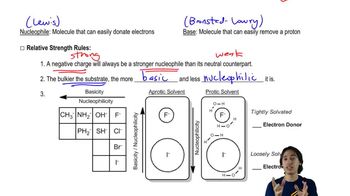
Understanding the difference between basicity and nucleophilicity.
Amine Structure and Reactivity
Amines are organic compounds derived from ammonia (NH3) by replacing one or more hydrogen atoms with alkyl or aryl groups. The basicity of amines is largely determined by the availability of the lone pair of electrons on the nitrogen atom, which can be affected by the electron-donating or withdrawing effects of substituents. Primary amines are generally stronger bases than secondary or tertiary amines due to less steric hindrance.
Recommended video:
Guided course
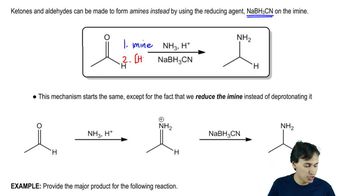
Reductive Amination
Hydroxide Ion (OH-) as a Base
The hydroxide ion (OH-) is a strong base commonly found in aqueous solutions. It readily accepts protons to form water, making it a powerful nucleophile. In the context of comparing basicity, compounds that can generate hydroxide ions in solution, such as sodium hydroxide (NaOH), are considered strong bases, often ranking higher than organic bases like amines or alcohols.
Recommended video:
Metal Ion Catalysis Concept 1
Related Practice
Textbook Question
839
views
Textbook Question
The following compounds can all react as bases.
a. For each compound, show its conjugate acid. Show any resonance forms if applicable.
926
views
Textbook Question
The following compounds can all react as acids.
a. For each compound, show its conjugate base. Show any resonance forms if applicable.
1004
views
Textbook Question
The following compounds can all react as acids.
b. Rank the conjugate bases in the order you would predict, from most stable to least stable.
878
views
Textbook Question
The following compounds can all react as bases.
b. Rank the conjugate acids in the order you would predict, from most stable to least stable.
623
views
Textbook Question
The following compounds can all react as acids.
c. Rank the original compounds in order, from strongest acid to weakest acid.
1742
views