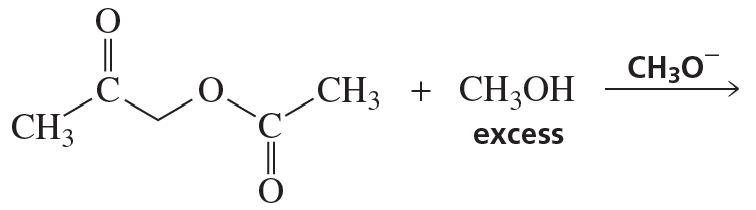
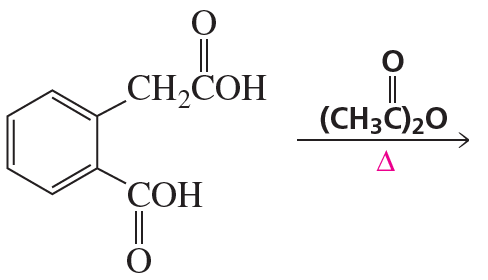
What are the products of the following reactions? g. h.
Verified step by step guidance
1
Step 1: For reaction (g), recognize that CH3OH (methanol) is in excess and CH3O- (methoxide ion) is present. This suggests a nucleophilic substitution or esterification reaction. Analyze the structure of the starting material to determine the reactive sites.
Step 2: Identify the functional groups in the starting material. If the starting material contains a leaving group (e.g., halide or tosylate), methoxide ion (CH3O-) will act as a nucleophile and replace the leaving group. If the starting material contains a carbonyl group, methanol may react to form an ester.
Step 3: Write the mechanism for the reaction. For nucleophilic substitution, show the attack of CH3O- on the electrophilic carbon attached to the leaving group, followed by the departure of the leaving group. For esterification, show the reaction of methanol with the carbonyl group, forming an ester and releasing a byproduct (e.g., water).
Step 4: For reaction (h), recognize that (CH3C=O)2O is acetic anhydride. Heating (Δ) acetic anhydride typically leads to its reaction with nucleophiles or decomposition. Analyze the conditions to predict the products.
Step 5: Write the mechanism for the reaction of acetic anhydride under heat. If no nucleophile is present, acetic anhydride may decompose into acetic acid and ketene. If a nucleophile is present, acetic anhydride may react to form an ester or amide, depending on the nucleophile.
Verified video answer for a similar problem:
This video solution was recommended by our tutors as helpful for the problem above
Play a video:
0 Comments
Key Concepts
Here are the essential concepts you must grasp in order to answer the question correctly.
Nucleophilic Substitution
Nucleophilic substitution is a fundamental reaction in organic chemistry where a nucleophile, such as methanol (CH3OH), attacks an electrophilic carbon atom, resulting in the replacement of a leaving group. In the given reaction, methanol acts as a nucleophile, forming a methoxy group (CH3O-) as a product when it reacts with an appropriate electrophile.
Nucleophiles and Electrophiles can react in Substitution Reactions.
Acid Anhydrides
Acid anhydrides, like (CH3C=O)2O, are compounds formed from two acyl groups and are reactive intermediates in organic synthesis. When heated (Δ), they can undergo reactions such as hydrolysis or nucleophilic acyl substitution, leading to the formation of carboxylic acids or esters, depending on the nucleophile involved.
Reaction conditions, including temperature, solvent, and the presence of catalysts, significantly influence the outcome of organic reactions. For instance, the use of excess methanol and heat in the reactions can drive the formation of specific products, such as esters or ethers, by favoring the nucleophilic attack and stabilizing the transition states.

 Verified step by step guidance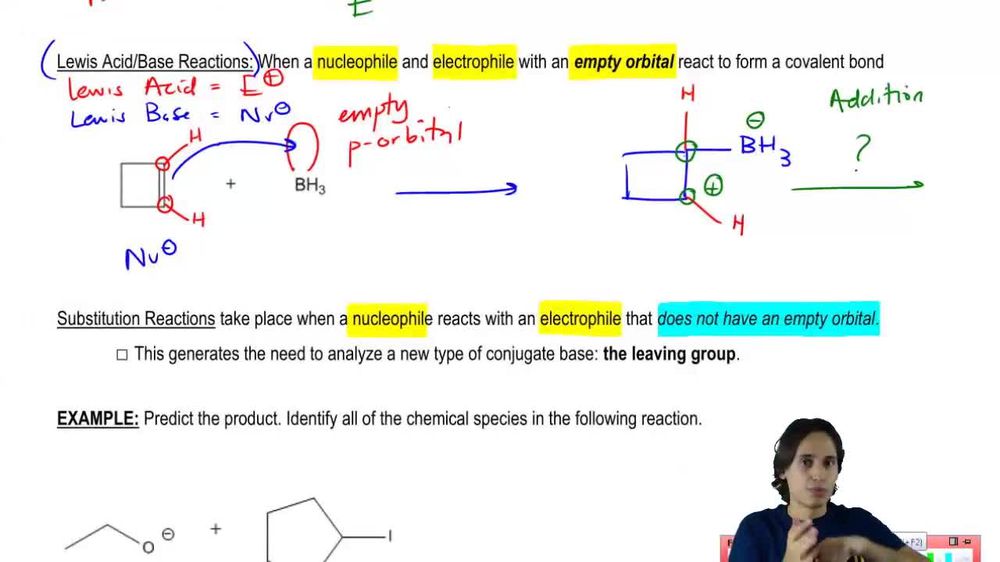
 01:47
01:47