Suggest a mechanism for the following elimination reactions. (c)
Verified step by step guidance
1
Identify the type of elimination reaction (E1 or E2) based on the substrate, base, and reaction conditions. For example, if the substrate is tertiary and the reaction occurs in the presence of a weak base, it is likely an E1 mechanism. If the base is strong and the substrate is secondary or tertiary, it is likely an E2 mechanism.
For an E1 mechanism: (1) The leaving group departs first, forming a carbocation intermediate. (2) Analyze the stability of the carbocation and consider any possible rearrangements (e.g., hydride or alkyl shifts) to form a more stable carbocation. (3) A proton is removed from a β-carbon by a base, leading to the formation of a double bond.
For an E2 mechanism: (1) The base abstracts a proton from a β-carbon that is anti-periplanar to the leaving group. (2) Simultaneously, the leaving group departs, and a double bond forms between the α-carbon and the β-carbon. Ensure the geometry of the substrate allows for the anti-periplanar arrangement.
Draw the structure of the product(s) formed. For E1, consider the possibility of multiple products due to carbocation rearrangements or regioselectivity (Zaitsev's rule: the more substituted alkene is favored). For E2, the product is typically determined by the anti-periplanar geometry and Zaitsev's rule.
Verify the stereochemistry and regiochemistry of the product(s). For E2, ensure the anti-periplanar geometry is satisfied. For E1, check for the most stable alkene product. If multiple products are possible, indicate the major and minor products based on stability.
Verified video answer for a similar problem:
This video solution was recommended by our tutors as helpful for the problem above
Video duration:
1m
Play a video:
0 Comments
Key Concepts
Here are the essential concepts you must grasp in order to answer the question correctly.
Elimination Reactions
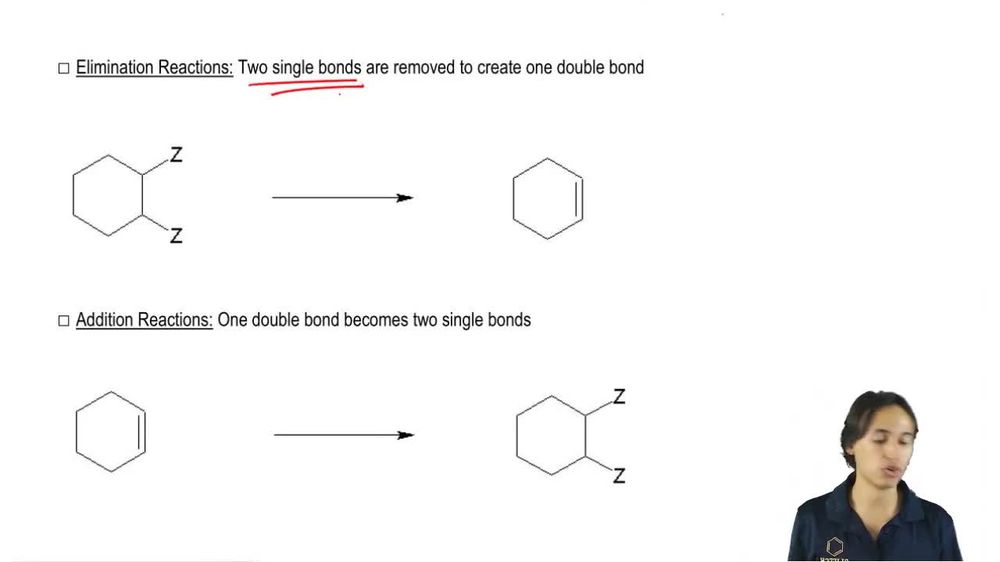
Elimination reactions are a type of organic reaction where two substituents are removed from a molecule, resulting in the formation of a double bond or a triple bond. These reactions typically involve the loss of a small molecule, such as water or hydrogen halide, and can occur via different mechanisms, primarily E1 and E2. Understanding the conditions and substrates that favor each mechanism is crucial for predicting the outcome of elimination reactions.
The E1 mechanism is a two-step process involving the formation of a carbocation intermediate, followed by deprotonation to form the alkene. In contrast, the E2 mechanism is a one-step process where the base abstracts a proton while the leaving group departs, leading to the simultaneous formation of the double bond. The choice between E1 and E2 depends on factors such as substrate structure, the strength of the base, and the reaction conditions.
Regioselectivity refers to the preference of a chemical reaction to yield one structural isomer over others when multiple products are possible. Stereoselectivity, on the other hand, involves the preference for the formation of one stereoisomer over another. In elimination reactions, these concepts are important as they influence the final product distribution, often determined by the stability of the intermediates and the sterics of the reacting species.

 1:28 minutes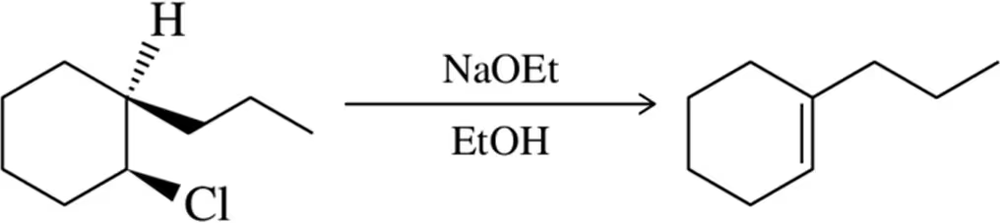
 Verified step by step guidance
 00:40
00:40