For each pair, choose the haloalkane that would react most quickly in an SN2 reaction. (d)
Verified step by step guidance
1
Step 1: Recall the key factors that influence the rate of an Sₙ2 reaction. The Sₙ2 mechanism involves a single-step bimolecular nucleophilic substitution, where the nucleophile attacks the electrophilic carbon and the leaving group departs simultaneously. The rate of the reaction depends on steric hindrance, the nature of the leaving group, and the structure of the haloalkane.
Step 2: Analyze the steric hindrance of the two haloalkanes. In an Sₙ2 reaction, the nucleophile must approach the electrophilic carbon from the opposite side of the leaving group. Therefore, primary haloalkanes react faster than secondary haloalkanes, and tertiary haloalkanes are typically unreactive due to steric hindrance.
Step 3: Compare the leaving groups in the two haloalkanes. A good leaving group is one that can stabilize the negative charge after departure. Halides such as iodide (I⁻) are better leaving groups than bromide (Br⁻), chloride (Cl⁻), or fluoride (F⁻).
Step 4: Evaluate the structure of the haloalkanes in the given pair. Determine whether each haloalkane is primary, secondary, or tertiary, and identify the leaving group in each molecule. The haloalkane with less steric hindrance and a better leaving group will react more quickly in an Sₙ2 reaction.
Step 5: Based on the analysis, choose the haloalkane that has the least steric hindrance and the best leaving group as the one that would react most quickly in an Sₙ2 reaction.
Verified video answer for a similar problem:
This video solution was recommended by our tutors as helpful for the problem above
Video duration:
2m
Play a video:
0 Comments
Key Concepts
Here are the essential concepts you must grasp in order to answer the question correctly.
Sₙ2 Reaction Mechanism
The Sₙ2 (bimolecular nucleophilic substitution) reaction mechanism involves a single concerted step where a nucleophile attacks an electrophile, leading to the simultaneous displacement of a leaving group. This mechanism is characterized by a second-order reaction rate, meaning the rate depends on the concentration of both the nucleophile and the substrate. Sₙ2 reactions typically favor primary and some secondary haloalkanes due to steric accessibility.
Steric hindrance refers to the prevention of chemical reactions due to the spatial arrangement of atoms within a molecule. In the context of Sₙ2 reactions, increased steric hindrance around the electrophilic carbon atom can slow down or inhibit the reaction. Therefore, primary haloalkanes, which have less steric hindrance, generally react faster than secondary or tertiary haloalkanes in Sₙ2 mechanisms.
The ability of a leaving group to depart from a molecule is crucial in determining the rate of Sₙ2 reactions. Good leaving groups, such as iodide or bromide, stabilize the negative charge after leaving, facilitating the reaction. Conversely, poor leaving groups, like fluoride or hydroxide, hinder the reaction process. Thus, the choice of haloalkane with a better leaving group can significantly influence the speed of the Sₙ2 reaction.

 2:17 minutes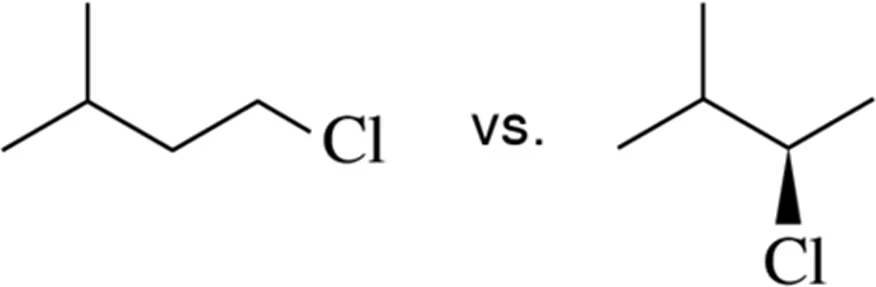
 Verified step by step guidance
 02:16
02:16