The following reaction, though run under standard solvolysis conditions, occurs via an SN2 reaction. Why?
Verified step by step guidance
1
Analyze the structure of the substrate: The substrate is a benzyl chloride derivative. Benzyl groups are known to stabilize carbocations due to resonance, which typically favors an SN1 mechanism. However, the stereochemistry of the product suggests an SN2 reaction.
Examine the stereochemistry of the product: The reaction results in an inversion of configuration at the carbon attached to the chlorine atom. This inversion is a hallmark of the SN2 mechanism, where the nucleophile attacks from the opposite side of the leaving group.
Consider the reaction conditions: The reaction is run under solvolysis conditions (CH3OH as the solvent and nucleophile). While solvolysis often favors SN1 reactions, the steric and electronic factors of the substrate can override this preference.
Evaluate steric hindrance: The carbon attached to the chlorine atom is a primary carbon. Primary carbons are less sterically hindered, making them more accessible to a nucleophile for a direct backside attack, which is characteristic of the SN2 mechanism.
Assess the role of the benzyl group: Although the benzyl group can stabilize a carbocation (favoring SN1), the primary nature of the carbon and the stereochemical outcome strongly suggest that the reaction proceeds via an SN2 pathway instead.
Verified video answer for a similar problem:
This video solution was recommended by our tutors as helpful for the problem above
Play a video:
0 Comments
Key Concepts
Here are the essential concepts you must grasp in order to answer the question correctly.
S<sub>N</sub>2 Mechanism
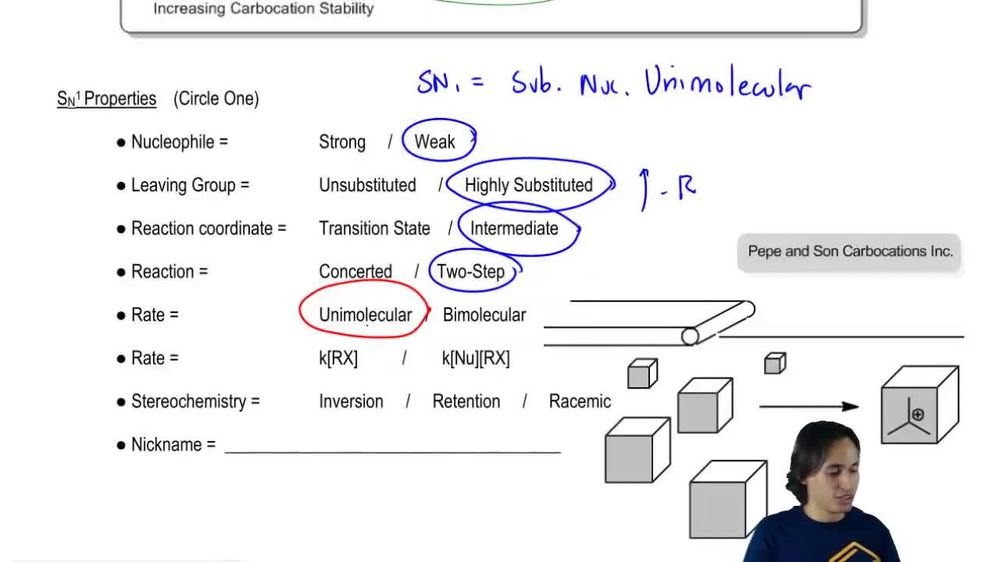
The S<sub>N</sub>2 mechanism is a type of nucleophilic substitution reaction where the nucleophile attacks the electrophile from the opposite side of the leaving group, resulting in a concerted reaction. This mechanism typically occurs with primary or secondary substrates and involves a single transition state. The stereochemistry is inverted at the carbon center where substitution occurs, which is crucial for understanding the reaction's outcome.
Solvolysis refers to a chemical reaction in which the solvent acts as a nucleophile, leading to the substitution of a leaving group in a substrate. In organic chemistry, this often involves polar protic solvents like alcohols or water. While solvolysis reactions can proceed via S<sub>N</sub>1 or S<sub>N</sub>2 mechanisms, the presence of a strong nucleophile and specific substrate structure can favor an S<sub>N</sub>2 pathway even under typical solvolysis conditions.
Steric hindrance refers to the prevention of chemical reactions due to the spatial arrangement of atoms within a molecule. In the context of nucleophilic substitution, bulky groups near the reactive site can impede the approach of the nucleophile, favoring an S<sub>N</sub>2 mechanism over S<sub>N</sub>1. In this reaction, the presence of sterically hindered groups can influence the pathway taken, making it essential to consider when predicting reaction outcomes.


 Verified step by step guidance
 05:29
05:29