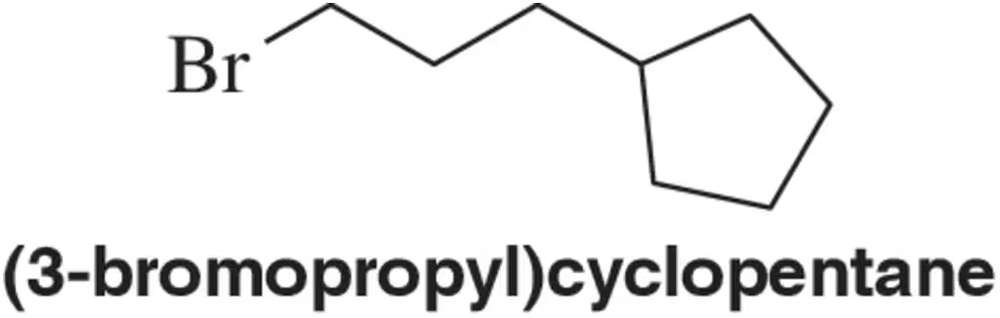
Can you make a 1° bromoalkane like (3-bromopropyl)cyclopentane using alkane halogenation? Why or why not?
Verified step by step guidance
1
Understand the concept of alkane halogenation: Alkane halogenation is a reaction where a halogen (such as bromine) is added to an alkane, typically in the presence of heat or light, resulting in the substitution of a hydrogen atom with a halogen atom.
Identify the structure of the desired product: (3-bromopropyl)cyclopentane is a primary bromoalkane where a bromine atom is attached to the third carbon of a propyl group, which is itself attached to a cyclopentane ring.
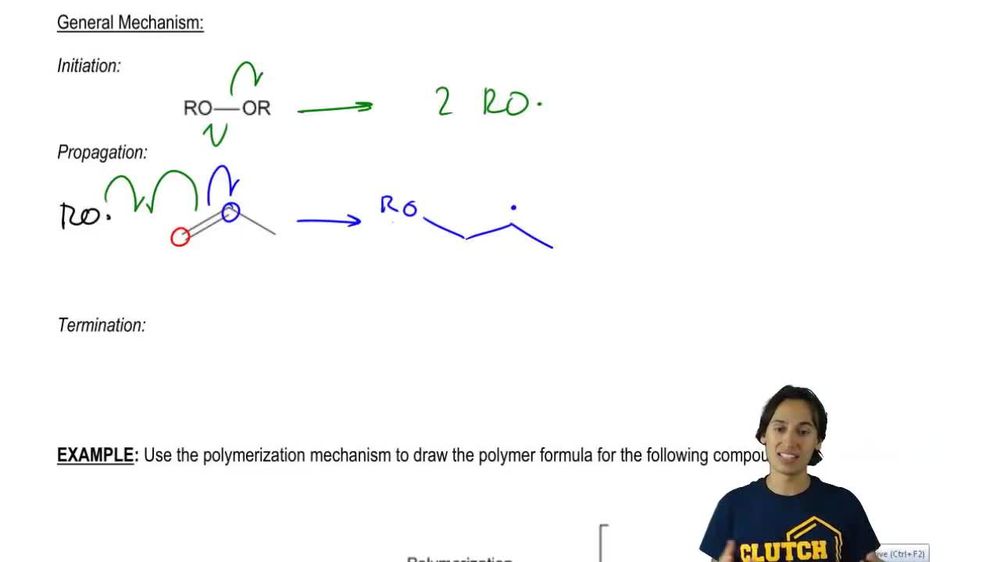
Consider the mechanism of free radical halogenation: This process involves the formation of free radicals and typically results in the substitution of hydrogen atoms on the most accessible or most stable carbon, often leading to a mixture of products.
Evaluate the selectivity of bromination: Bromination is more selective than chlorination, favoring substitution at the most stable radical position, which is often a tertiary or secondary carbon rather than a primary carbon.
Conclude the feasibility: Since the desired product is a primary bromoalkane, and free radical halogenation tends to favor more stable radical positions, it is unlikely to selectively produce (3-bromopropyl)cyclopentane using simple alkane halogenation.
Verified video answer for a similar problem:
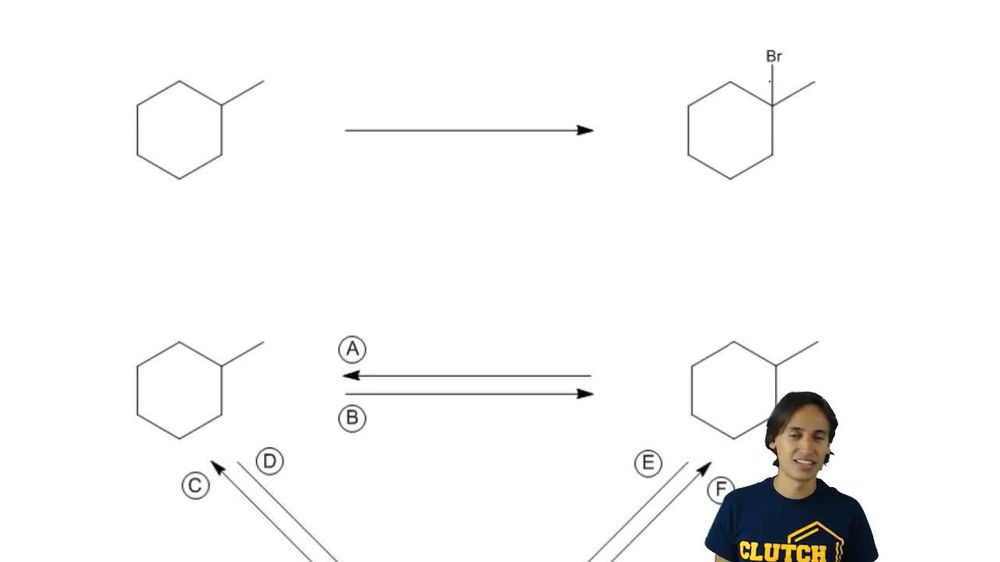
This video solution was recommended by our tutors as helpful for the problem above
Video duration:
5m
Play a video:
0 Comments
Key Concepts
Here are the essential concepts you must grasp in order to answer the question correctly.
Alkane Halogenation
Alkane halogenation is a reaction where a halogen, such as bromine, reacts with an alkane in the presence of heat or light to form a haloalkane. This process typically involves the formation of free radicals and is not selective, often leading to a mixture of products. The lack of selectivity makes it challenging to produce a specific haloalkane, such as a 1° bromoalkane, without forming other isomers.
The radical mechanism is a chain reaction process that involves the formation, propagation, and termination of free radicals. In alkane halogenation, the initiation step generates radicals, which then react with alkanes to form new radicals and haloalkanes. This mechanism is non-selective, often leading to multiple substitution products, which complicates the synthesis of specific haloalkanes like 1° bromoalkanes.
Selectivity in halogenation refers to the preference for halogen atoms to substitute hydrogen atoms at specific positions on the carbon chain. In the case of bromination, the reaction is more selective than chlorination, favoring the formation of more stable radicals. However, achieving exclusive formation of a 1° bromoalkane is difficult due to competing reactions that can lead to secondary or tertiary bromoalkanes, especially in complex molecules like (3-bromopropyl)cyclopentane.