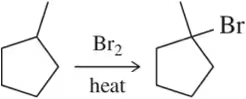
Suggest a mechanism for the following reactions. (a)
Verified step by step guidance
1
Identify the type of reaction: Determine if the reaction is a substitution, addition, elimination, or rearrangement. This will guide the mechanism you propose.
Analyze the reactants and products: Look at the functional groups present in the reactants and products. This will help you understand what bonds are being broken and formed.
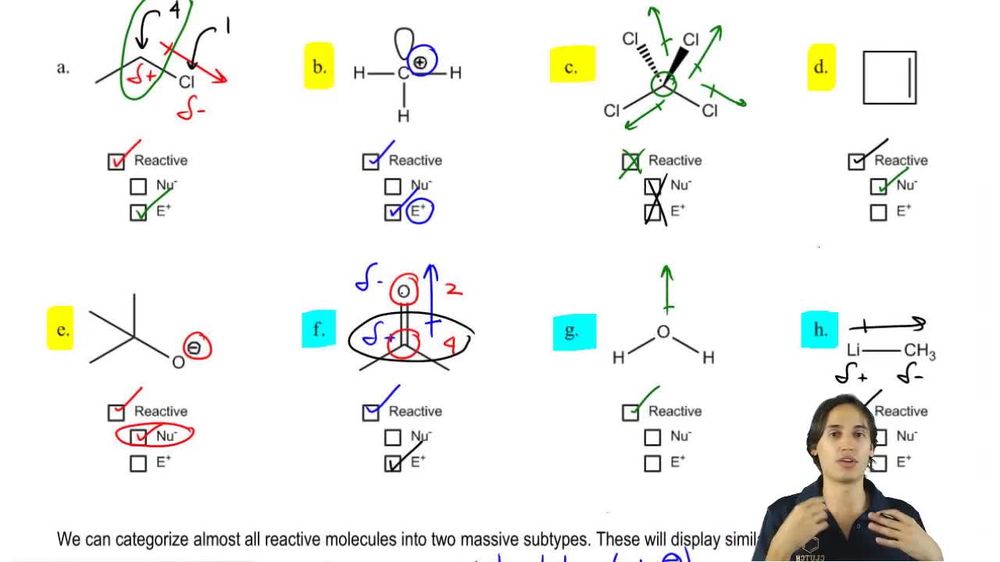
Determine the reactive sites: Identify the nucleophiles and electrophiles in the reaction. Nucleophiles are electron-rich species that donate electrons, while electrophiles are electron-deficient species that accept electrons.
Propose the first step of the mechanism: Typically, this involves the attack of the nucleophile on the electrophile, leading to the formation of a new bond. Use curved arrows to show the movement of electrons.
Continue the mechanism: Follow through with subsequent steps, such as the departure of a leaving group, rearrangement, or proton transfer, until you reach the final product. Ensure each step is chemically reasonable and follows the principles of organic chemistry.
Verified video answer for a similar problem:
This video solution was recommended by our tutors as helpful for the problem above
Video duration:
4m
Play a video:
0 Comments
Key Concepts
Here are the essential concepts you must grasp in order to answer the question correctly.
Reaction Mechanism
A reaction mechanism is a detailed step-by-step description of how a chemical reaction occurs at the molecular level. It includes the sequence of elementary steps, the movement of electrons, and the formation and breaking of bonds. Understanding mechanisms helps predict the products and intermediates formed during the reaction.
Electrophiles are species that accept electron pairs, while nucleophiles donate electron pairs. These interactions are fundamental in organic reactions, where nucleophiles attack electrophiles to form new bonds. Identifying these species in a reaction is crucial for understanding how the mechanism proceeds.
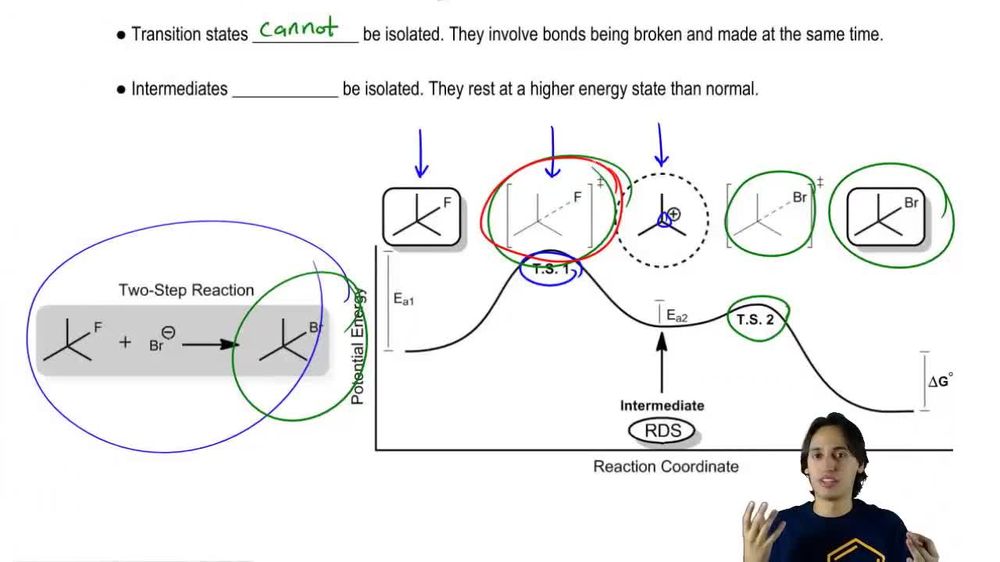
Transition states are high-energy states that occur during the conversion of reactants to products, while intermediates are species that form temporarily during the reaction. Recognizing these can help elucidate the energy profile and stability of the reaction pathway, aiding in the prediction of reaction outcomes.