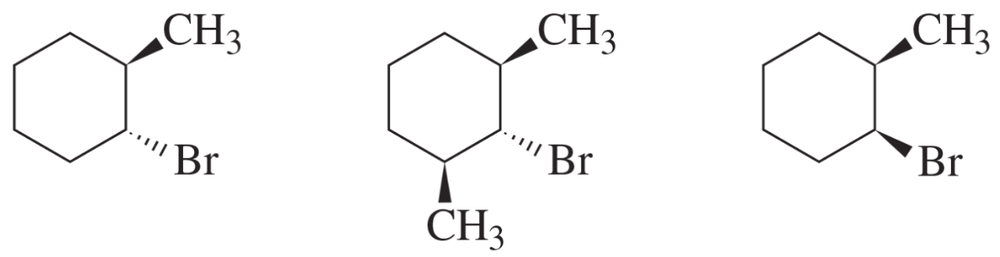
Rank the following from most reactive to least reactive in an E2 reaction:
Verified step by step guidance
1
Analyze the structures provided: The three molecules are cyclohexane derivatives with a bromine atom and methyl groups attached. The bromine atom is the leaving group in the E2 reaction, and the methyl groups influence the reactivity based on steric hindrance and the availability of anti-periplanar β-hydrogens.
Recall the requirements for an E2 reaction: The reaction requires a strong base and a β-hydrogen that is anti-periplanar to the leaving group. The geometry of the molecule plays a critical role in determining the reactivity.
Evaluate the first structure: The bromine atom is in the axial position, and the methyl group is in the equatorial position. This arrangement allows for anti-periplanar β-hydrogens, making the molecule reactive in an E2 reaction.
Evaluate the second structure: The bromine atom is in the axial position, and there are two methyl groups attached to the ring. The additional methyl group increases steric hindrance, but anti-periplanar β-hydrogens are still available, making this structure slightly less reactive than the first.
Evaluate the third structure: The bromine atom is in the equatorial position, which prevents the anti-periplanar geometry required for an E2 reaction. This structure is the least reactive because the necessary alignment for elimination is not possible.
Verified video answer for a similar problem:

This video solution was recommended by our tutors as helpful for the problem above
Video duration:
7m
Play a video:
0 Comments
Key Concepts
Here are the essential concepts you must grasp in order to answer the question correctly.
E2 Reaction Mechanism
The E2 reaction is a bimolecular elimination process where a base abstracts a proton from a β-carbon while a leaving group departs from the α-carbon, resulting in the formation of a double bond. The reaction is concerted, meaning that bond-breaking and bond-forming occur simultaneously. The strength of the base and the structure of the substrate significantly influence the reaction rate and outcome.
The reactivity of substrates in E2 reactions is heavily influenced by their steric environment. Bulky groups near the leaving group can hinder the approach of the base, reducing reactivity. Additionally, the presence of more substituted carbons (like tertiary over secondary or primary) generally leads to increased reactivity due to better stabilization of the transition state.
The ability of a leaving group to depart is crucial in determining the reactivity of a substrate in an E2 reaction. Good leaving groups, such as halides (e.g., Cl, Br, I), stabilize the transition state and facilitate the elimination process. The strength of the bond between the leaving group and the carbon atom also plays a role, with weaker bonds leading to better leaving groups and thus higher reactivity.