A chemist allows some pure (2S,3R)-3-bromo-2,3-diphenylpentane to react with a solution of sodium ethoxide (NaOCH2CH3) in ethanol. The products are two alkenes: A (cis-trans mixture) and B, a single pure isomer. Under the same conditions, the reaction of (2S,3S)-3-bromo-2,3-diphenylpentane gives two alkenes, A (cis-trans mixture) and C. Upon catalytic hydrogenation, all three of these alkenes (A, B, and C) give 2,3-diphenylpentane. Determine the structures of A, B, and C; give equations for their formation; and explain the stereospecificity of these reactions.
Verified step by step guidance
1
Step 1: Analyze the reaction conditions. The reaction involves sodium ethoxide (NaOCH2CH3) in ethanol, which is a strong base. This suggests that the reaction proceeds via an E2 elimination mechanism, where the base abstracts a proton from a β-carbon, leading to the formation of an alkene.
Step 2: Consider the stereochemistry of the starting materials. The compound (2S,3R)-3-bromo-2,3-diphenylpentane has specific stereochemistry at the 2nd and 3rd carbons. In an E2 elimination, the anti-periplanar geometry is required, meaning the β-hydrogen and the leaving group (Br) must be in opposite planes. This stereochemical requirement will influence the products formed.
Step 3: Predict the alkenes formed from (2S,3R)-3-bromo-2,3-diphenylpentane. The anti-periplanar elimination leads to two possible alkenes: A (a cis-trans mixture due to rotation around the double bond) and B (a single pure isomer, likely due to stereospecificity). The stereochemistry of the starting material dictates the geometry of the double bond in B.
Step 4: Analyze the reaction of (2S,3S)-3-bromo-2,3-diphenylpentane. This compound has different stereochemistry at the 3rd carbon compared to the first starting material. The anti-periplanar requirement will again dictate the elimination pathway, leading to alkenes A (cis-trans mixture) and C (a single pure isomer with distinct stereochemistry).
Step 5: Explain the stereospecificity and hydrogenation results. Upon catalytic hydrogenation, all alkenes (A, B, and C) are reduced to 2,3-diphenylpentane, indicating that the double bonds are in the same carbon framework. The stereospecificity arises from the anti-periplanar geometry required in the E2 elimination, which determines the configuration of the double bonds in B and C.
Verified video answer for a similar problem:
This video solution was recommended by our tutors as helpful for the problem above
Video duration:
19m
Play a video:
0 Comments
Key Concepts
Here are the essential concepts you must grasp in order to answer the question correctly.
Stereochemistry
Stereochemistry is the study of the spatial arrangement of atoms in molecules and how this affects their chemical behavior. In this question, the stereochemistry of the starting materials (2S,3R and 2S,3S) is crucial for understanding the formation of the alkenes A, B, and C. The terms 'cis' and 'trans' refer to specific geometric isomers that arise from the restricted rotation around double bonds, which is essential for predicting the products of the reactions.
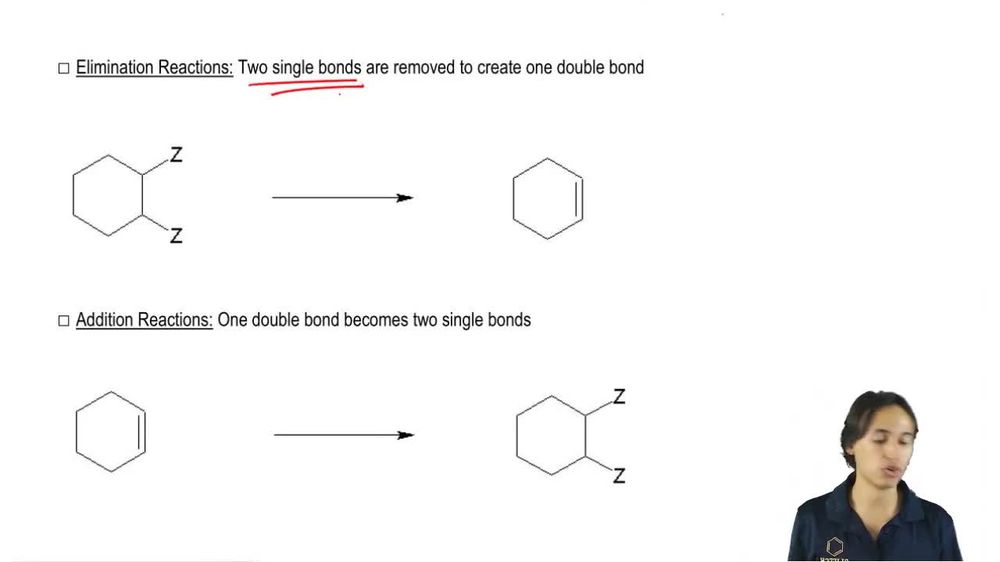
Elimination reactions involve the removal of atoms or groups from a molecule, resulting in the formation of a double bond. In this case, sodium ethoxide acts as a base, facilitating the elimination of bromide from the bromoalkane to form alkenes. Understanding the mechanism of elimination, including the E2 pathway, is key to predicting the structures of the resulting alkenes and their stereochemical outcomes.
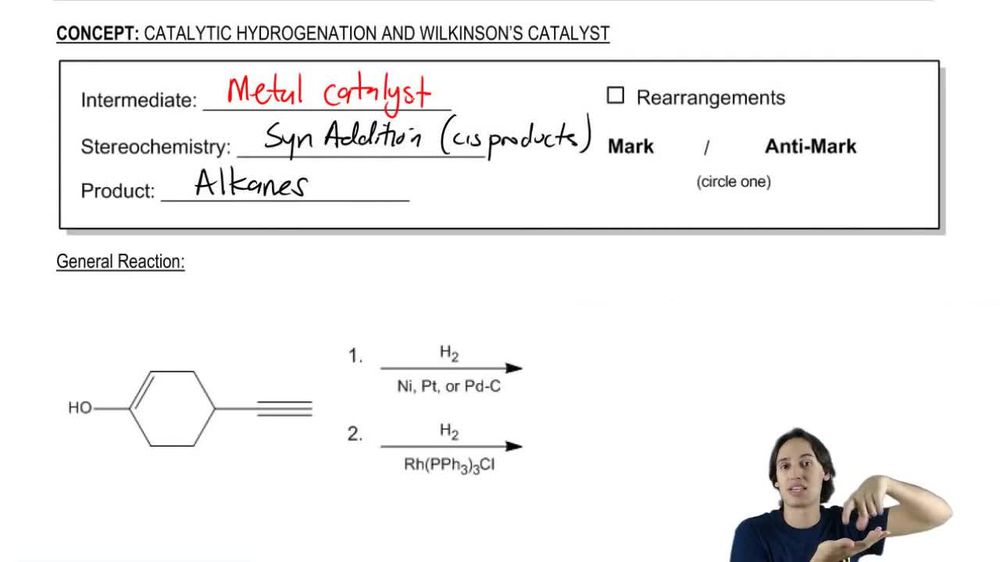
Catalytic hydrogenation is a reaction that involves the addition of hydrogen (H2) across a double bond, typically using a metal catalyst. This process converts alkenes into alkanes, and in this question, it is used to illustrate that all three alkenes (A, B, and C) yield the same product, 2,3-diphenylpentane. Recognizing the role of hydrogenation helps in understanding the relationship between the alkenes and their saturated counterpart.