Ch. 17 - Reactions at the Alpha-Carbon
Bruice - Organic Chemistry 8th Edition
Bruice8th EditionOrganic ChemistryISBN: 9780135213711Not the one you use?Change textbook
Chapter 18, Problem 35d

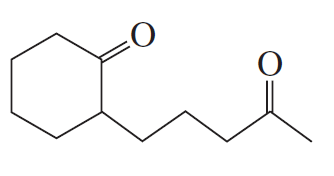
Draw the product of the reaction of each of the following compounds with a base:
d. Chemical structure illustrating the product of an intramolecular aldol condensation reaction with a base.

Verified step by step guidance
1
Identify the functional group in the compound provided. Determine if the compound contains acidic protons, such as those in alcohols, phenols, carboxylic acids, or alpha-hydrogens adjacent to carbonyl groups, which can react with a base.
Determine the type of base used in the reaction. Strong bases (e.g., hydroxide ion, alkoxide ion) will deprotonate acidic hydrogens, while weaker bases may only partially react.
Locate the most acidic hydrogen in the compound. For example, in alcohols, the hydrogen on the hydroxyl group (-OH) is acidic, while in carbonyl compounds, alpha-hydrogens are acidic due to resonance stabilization of the resulting enolate ion.
Write the deprotonation reaction. Use a curved arrow mechanism to show the base abstracting the acidic proton, resulting in the formation of the conjugate base of the compound and the conjugate acid of the base.
Draw the final product, which is the conjugate base of the original compound. Ensure that the negative charge is placed on the appropriate atom, such as oxygen in alcohols or carbon in enolates, and that resonance structures are considered if applicable.

Verified video answer for a similar problem:

This video solution was recommended by our tutors as helpful for the problem above.
Was this helpful?

Key Concepts

Here are the essential concepts you must grasp in order to answer the question correctly.

Acid-Base Reactions

Acid-base reactions involve the transfer of protons (H+) between reactants. In organic chemistry, bases can deprotonate acidic functional groups, leading to the formation of new products. Understanding the strength of acids and bases, as well as their reactivity, is crucial for predicting the outcome of these reactions.
Recommended video:
Guided course
02:49
The Lewis definition of acids and bases.

Functional Groups

Functional groups are specific groups of atoms within molecules that are responsible for the characteristic chemical reactions of those molecules. Identifying the functional groups present in the compounds involved in the reaction is essential for determining how they will interact with a base and what products will form.
Recommended video:
Guided course
02:36
Identifying Functional Groups

Reaction Mechanisms

Reaction mechanisms describe the step-by-step process by which reactants are converted into products. Understanding the mechanism of a reaction helps predict the products formed when a compound reacts with a base, including any intermediates that may be involved and the overall energy changes during the reaction.
Recommended video:
Guided course
02:16
Heck Reaction Mechanism