Write the rate law for the following reaction and identify which molecules are present in the rate-determining step. Draw a possible transition state and propose a mechanism.
Verified step by step guidance
1
Step 1: Begin by analyzing the reaction provided. Identify whether it is a single-step reaction or a multi-step reaction. If it is multi-step, determine which step is the slowest (rate-determining step) based on the information given or implied in the problem.
Step 2: Write the rate law for the reaction. The rate law is determined by the molecularity of the rate-determining step. For example, if the slow step involves one molecule of A and one molecule of B, the rate law would be: . Ensure to use the stoichiometry of the slow step, not the overall reaction.
Step 3: Identify the molecules involved in the rate-determining step. These are the reactants that appear in the slowest step of the mechanism. For example, if the slow step is A + B → C, then A and B are the molecules present in the rate-determining step.
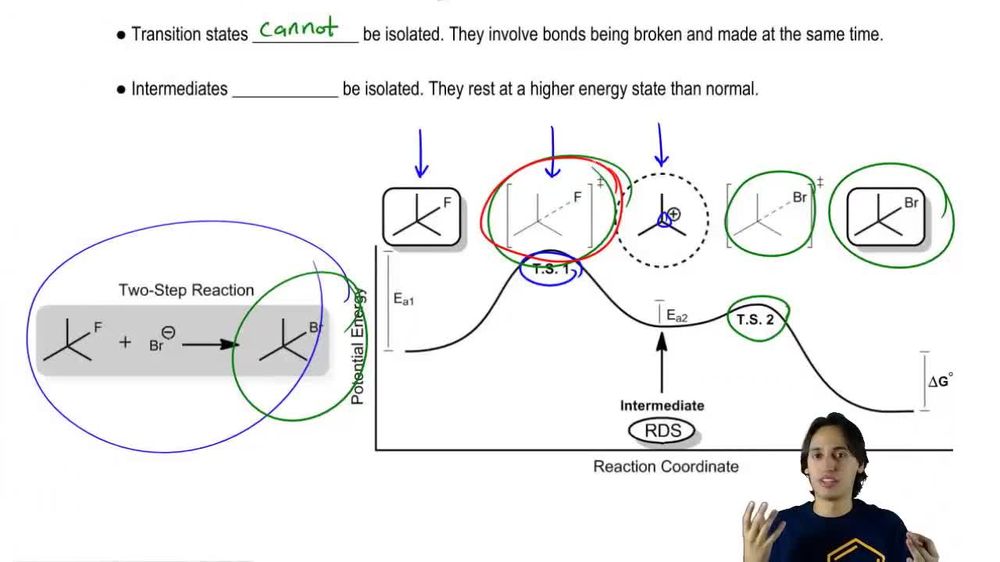
Step 4: Draw a possible transition state for the rate-determining step. The transition state represents the highest energy point along the reaction coordinate for that step. Include partial bonds and charges to show the intermediate state between reactants and products.
Step 5: Propose a mechanism for the reaction. Break the reaction into individual steps, ensuring that the sum of all steps equals the overall reaction. Include intermediates, catalysts, and any other species involved. Verify that the rate law derived from the mechanism matches the experimentally determined rate law.
Verified video answer for a similar problem:
This video solution was recommended by our tutors as helpful for the problem above
Video duration:
6m
Play a video:
0 Comments
Key Concepts
Here are the essential concepts you must grasp in order to answer the question correctly.
Rate Law
The rate law of a chemical reaction expresses the relationship between the reaction rate and the concentration of reactants. It is typically formulated as rate = k[A]^m[B]^n, where k is the rate constant, and m and n are the orders of the reaction with respect to reactants A and B. Understanding the rate law is crucial for predicting how changes in concentration affect the speed of the reaction.
The rate-determining step (RDS) is the slowest step in a reaction mechanism that controls the overall reaction rate. It is often the step with the highest activation energy and can be identified by analyzing the transition states and intermediates involved. Recognizing the RDS is essential for determining which molecules influence the rate law and for understanding the mechanism of the reaction.
Transition state theory posits that during a chemical reaction, reactants pass through a high-energy transition state before forming products. This state represents a point of maximum energy along the reaction pathway and is crucial for understanding the activation energy required for the reaction. Drawing a possible transition state helps visualize the arrangement of atoms and bonds at this critical juncture, aiding in the proposal of a reaction mechanism.