For the following acid–base reaction, (d) calculate ∆G° at 298 K.
Verified step by step guidance
1
Step 1: Identify the acid and base in the reaction. Determine the conjugate acid and conjugate base formed after the reaction. This will help in understanding the equilibrium of the reaction.
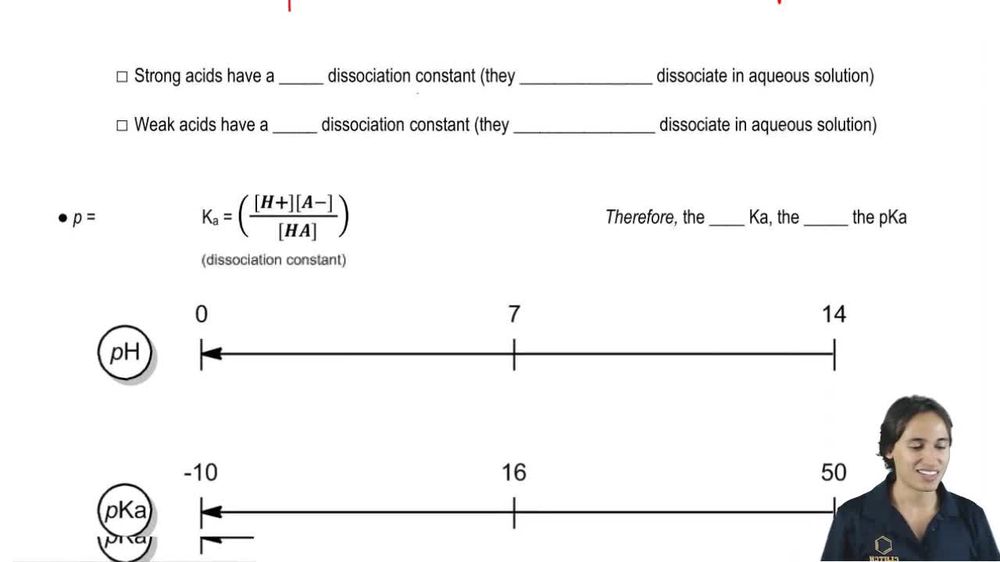
Step 2: Use the pKa values of the acid and conjugate acid to calculate the equilibrium constant (K_eq) for the reaction. The relationship between pKa and K_eq is given by \( K_{eq} = 10^{\Delta pKa} \), where \( \Delta pKa = pKa_{acid} - pKa_{conjugate acid} \).
Step 3: Recall the relationship between \( \Delta G^\circ \) and \( K_{eq} \): \( \Delta G^\circ = -RT \ln K_{eq} \). Here, \( R \) is the gas constant (8.314 J/mol·K), \( T \) is the temperature in Kelvin (298 K), and \( K_{eq} \) is the equilibrium constant calculated in Step 2.
Step 4: Substitute the values of \( R \), \( T \), and \( K_{eq} \) into the equation \( \Delta G^\circ = -RT \ln K_{eq} \). Ensure that \( K_{eq} \) is expressed in a form suitable for logarithmic calculation.
Step 5: Perform the calculation to determine \( \Delta G^\circ \). The result will be in joules per mole (J/mol). If needed, convert the value to kilojoules per mole (kJ/mol) by dividing by 1000.
Verified video answer for a similar problem:
This video solution was recommended by our tutors as helpful for the problem above
Video duration:
6m
Play a video:
0 Comments
Key Concepts
Here are the essential concepts you must grasp in order to answer the question correctly.
Gibbs Free Energy (∆G)
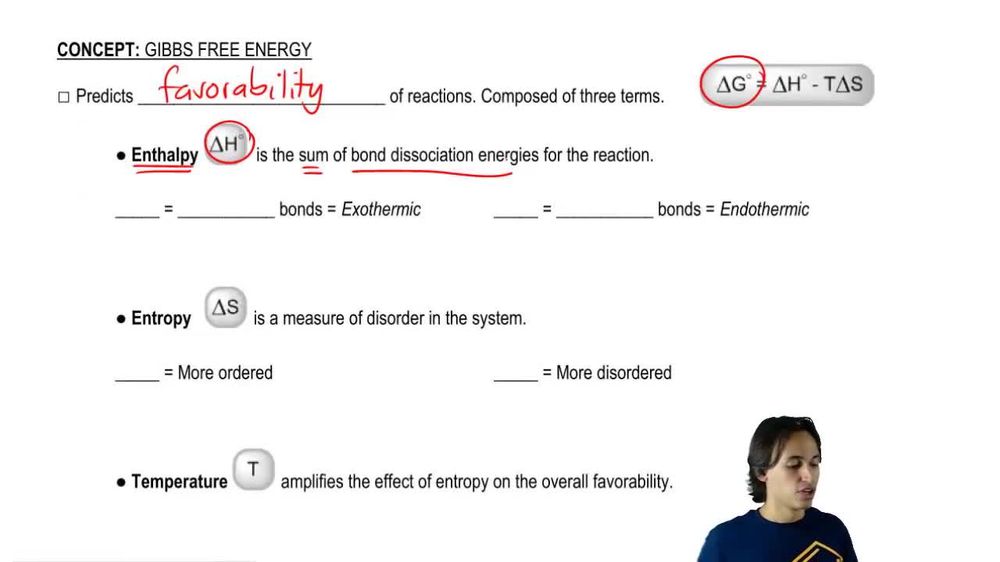
Gibbs Free Energy (∆G) is a thermodynamic potential that measures the maximum reversible work obtainable from a thermodynamic system at constant temperature and pressure. It is a crucial concept in predicting the spontaneity of a reaction; a negative ∆G indicates a spontaneous process, while a positive ∆G suggests non-spontaneity. The standard Gibbs free energy change (∆G°) is calculated under standard conditions (1 atm, 1 M concentration, and 298 K).
Breaking down the different terms of the Gibbs Free Energy equation.
Acid-Base Reactions
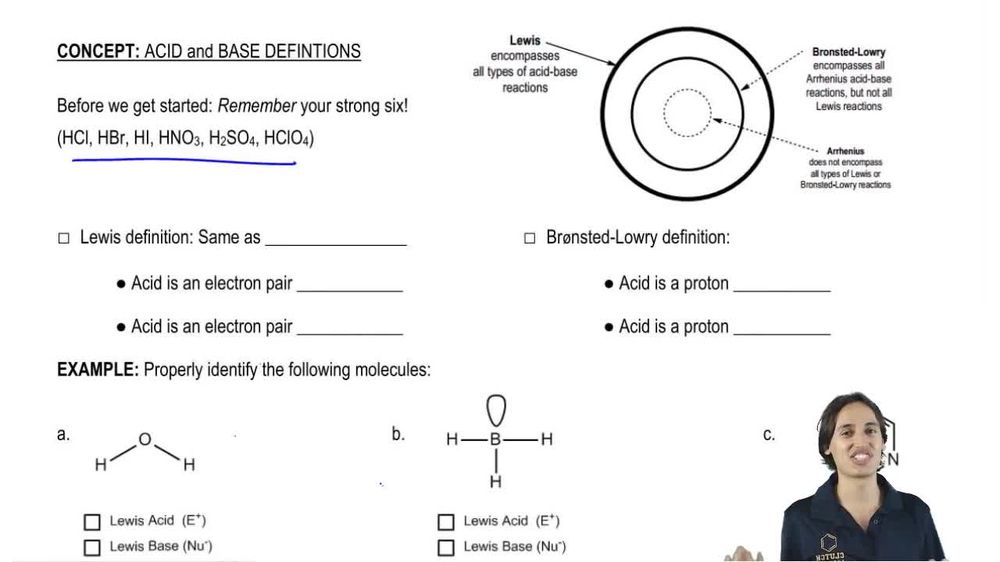
Acid-base reactions involve the transfer of protons (H⁺ ions) between reactants. In these reactions, acids donate protons, while bases accept them. Understanding the strength of acids and bases, as well as their dissociation constants (Ka and Kb), is essential for calculating the equilibrium position and the Gibbs free energy change associated with the reaction. The reaction's direction and extent can significantly influence the overall energy change.
The equilibrium constant (K) quantifies the ratio of the concentrations of products to reactants at equilibrium for a given reaction. It is related to the standard Gibbs free energy change by the equation ∆G° = -RT ln(K), where R is the universal gas constant and T is the temperature in Kelvin. Knowing K allows for the calculation of ∆G° and provides insight into the favorability of the reaction under standard conditions.