Rank the following compounds from highest boiling to lowest boiling:
Verified step by step guidance
1
Step 1: Identify the functional groups in each compound. Compound A contains three amine groups (-NH2), compound B contains two amine groups, compound C contains one amine group, compound D contains one hydroxyl group (-OH), and compound E is a hydrocarbon with no polar functional groups.
Step 2: Understand the impact of functional groups on boiling points. Polar functional groups like -NH2 and -OH can form hydrogen bonds, which significantly increase boiling points. Hydrocarbons without polar groups have lower boiling points due to weaker intermolecular forces (London dispersion forces).
Step 3: Consider the number of hydrogen bonding sites. Compound A has the most hydrogen bonding sites due to three -NH2 groups, followed by compound B with two -NH2 groups, compound D with one -OH group, and compound C with one -NH2 group. Compound E has no hydrogen bonding capability.
Step 4: Evaluate molecular size and branching. Larger molecules with less branching tend to have higher boiling points due to increased surface area for intermolecular forces. Compound E is branched, which reduces its boiling point compared to straight-chain compounds.
Step 5: Rank the compounds based on boiling points. The order from highest boiling to lowest boiling is likely: A > B > D > C > E, considering the number of hydrogen bonding sites and the molecular structure.
Verified video answer for a similar problem:
This video solution was recommended by our tutors as helpful for the problem above
Video duration:
5m
Play a video:
0 Comments
Key Concepts
Here are the essential concepts you must grasp in order to answer the question correctly.
Boiling Point and Intermolecular Forces
The boiling point of a compound is influenced by the strength of its intermolecular forces. Compounds with stronger forces, such as hydrogen bonding, dipole-dipole interactions, or ionic interactions, typically have higher boiling points. Understanding these forces helps predict the boiling point ranking of different compounds.
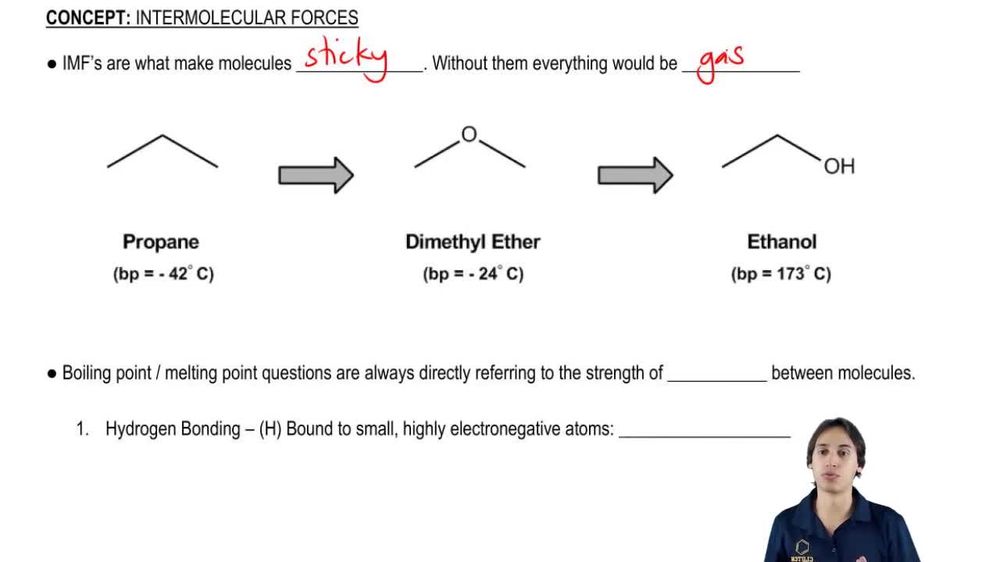
How IMFs are related to melting and boiling points.
Hydrogen Bonding
Hydrogen bonding occurs when a hydrogen atom covalently bonded to a highly electronegative atom (like N or O) interacts with another electronegative atom. This type of bonding significantly increases the boiling point of compounds, as seen in alcohols and amines, due to the additional energy required to break these interactions during phase changes.
The molecular structure and polarity of a compound affect its boiling point. Polar molecules tend to have higher boiling points than nonpolar molecules due to stronger dipole-dipole interactions. Additionally, branching in carbon chains can reduce boiling points by decreasing surface area and thus the strength of van der Waals forces.