Which of the following compounds forms hydrogen bonds between its molecules? 1. CH3CH2OCH2CH2OH 2. CH3CH2N(CH3)2 3. CH3CH2CH2CH2Br
Verified step by step guidance
1
Step 1: Understand the concept of hydrogen bonding. Hydrogen bonds occur when a hydrogen atom is covalently bonded to a highly electronegative atom (such as oxygen, nitrogen, or fluorine) and interacts with another electronegative atom in a nearby molecule.
Step 2: Analyze compound 1 (CH3CH2OCH2CH2OH). This molecule contains an -OH group, which has a hydrogen atom bonded to oxygen, a highly electronegative atom. This allows the molecule to form hydrogen bonds with other molecules of the same type.
Step 3: Analyze compound 2 (CH3CH2N(CH3)2). This molecule contains a nitrogen atom, which is electronegative, but there is no hydrogen directly bonded to the nitrogen. Therefore, it cannot form hydrogen bonds between its molecules.
Step 4: Analyze compound 3 (CH3CH2CH2CH2Br). This molecule contains a bromine atom, which is electronegative, but bromine is not sufficiently electronegative to form hydrogen bonds, and there is no hydrogen directly bonded to bromine. Thus, it cannot form hydrogen bonds between its molecules.
Step 5: Conclude that compound 1 (CH3CH2OCH2CH2OH) is the only compound among the three that can form hydrogen bonds between its molecules due to the presence of the -OH group.
Verified video answer for a similar problem:
This video solution was recommended by our tutors as helpful for the problem above
Video duration:
3m
Play a video:
0 Comments
Key Concepts
Here are the essential concepts you must grasp in order to answer the question correctly.
Hydrogen Bonding
Hydrogen bonding is a type of intermolecular force that occurs when a hydrogen atom covalently bonded to a highly electronegative atom, such as oxygen or nitrogen, experiences an attraction to another electronegative atom. This interaction is crucial for determining the physical properties of compounds, such as boiling and melting points. Compounds capable of hydrogen bonding typically have -OH or -NH groups.
Functional groups are specific groups of atoms within molecules that are responsible for the characteristic chemical reactions of those molecules. In organic chemistry, common functional groups include alcohols (-OH), amines (-NH2), and halides (like -Br). Identifying functional groups helps predict the behavior of compounds, including their ability to form hydrogen bonds.
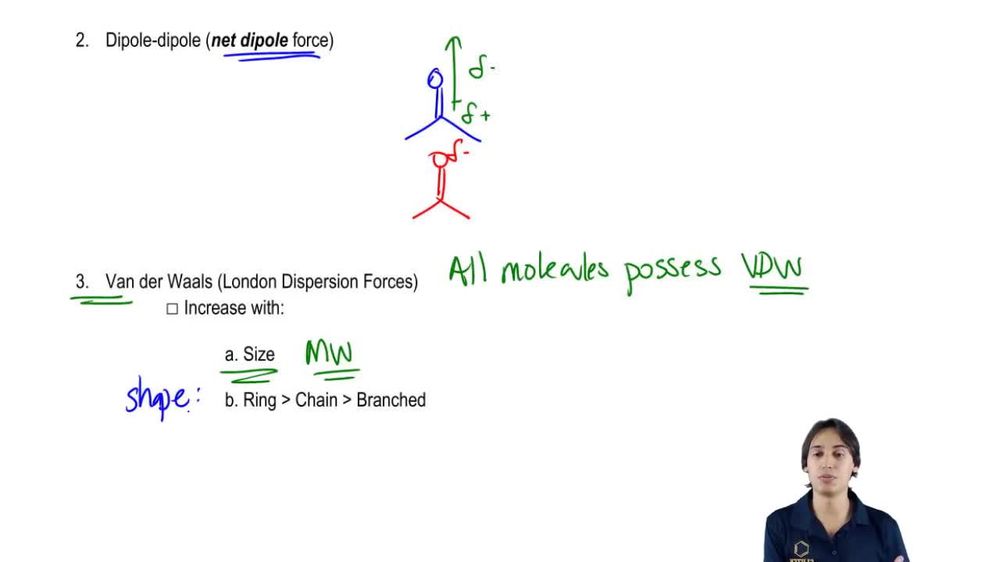
Intermolecular forces are the forces of attraction or repulsion between neighboring particles (atoms, molecules, or ions). These forces include hydrogen bonds, dipole-dipole interactions, and London dispersion forces. Understanding these forces is essential for predicting the physical properties of substances, such as solubility and boiling points, and determining which compounds can form hydrogen bonds.

 3:40 minutes
 Verified step by step guidance
 00:48
00:48