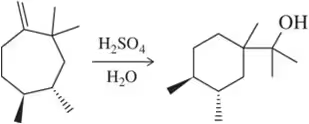
Suggest an arrow-pushing mechanism that accounts for the formation of the following products. (a)
Verified step by step guidance
1
Step 1: Identify the reactants and products in the given reaction. Carefully examine the molecular structures to determine the functional groups involved and any changes in bonding patterns between reactants and products.
Step 2: Determine the type of reaction mechanism (e.g., nucleophilic substitution, elimination, addition, etc.) based on the functional groups and the transformation observed. Consider whether the reaction involves electron movement, bond formation, or bond breaking.
Step 3: Begin the arrow-pushing mechanism by identifying the electron-rich species (nucleophile) and electron-deficient species (electrophile). Use curved arrows to show the movement of electrons from the nucleophile to the electrophile.
Step 4: Account for intermediate species, if any, formed during the reaction. For example, if a carbocation or an anion is formed, show how it is stabilized or reacts further to form the final product. Ensure all steps follow the rules of valency and charge conservation.
Step 5: Complete the mechanism by showing the formation of the final products. Verify that all atoms and charges are balanced, and ensure the curved arrows accurately depict the electron flow leading to the products.
Verified video answer for a similar problem:
This video solution was recommended by our tutors as helpful for the problem above
Play a video:
0 Comments
Key Concepts
Here are the essential concepts you must grasp in order to answer the question correctly.
Arrow-Pushing Mechanism
Arrow-pushing mechanisms are diagrams used in organic chemistry to illustrate the movement of electrons during chemical reactions. They show how nucleophiles (electron-rich species) and electrophiles (electron-deficient species) interact, allowing students to visualize the flow of electrons and the formation of bonds. Understanding this mechanism is crucial for predicting reaction outcomes and product formation.
Nucleophiles are species that donate an electron pair to form a chemical bond, while electrophiles are species that accept an electron pair. Recognizing the roles of these species in a reaction is essential for understanding how products are formed. The strength and reactivity of nucleophiles and electrophiles can significantly influence the reaction pathway and the final products.
A reaction mechanism is a step-by-step description of how a chemical reaction occurs, detailing the sequence of bond-breaking and bond-forming events. Understanding the mechanism helps predict the products of a reaction and the conditions under which it occurs. It also provides insight into the stability of intermediates and transition states, which are critical for grasping the overall process.

 Verified step by step guidance
 04:32
04:32