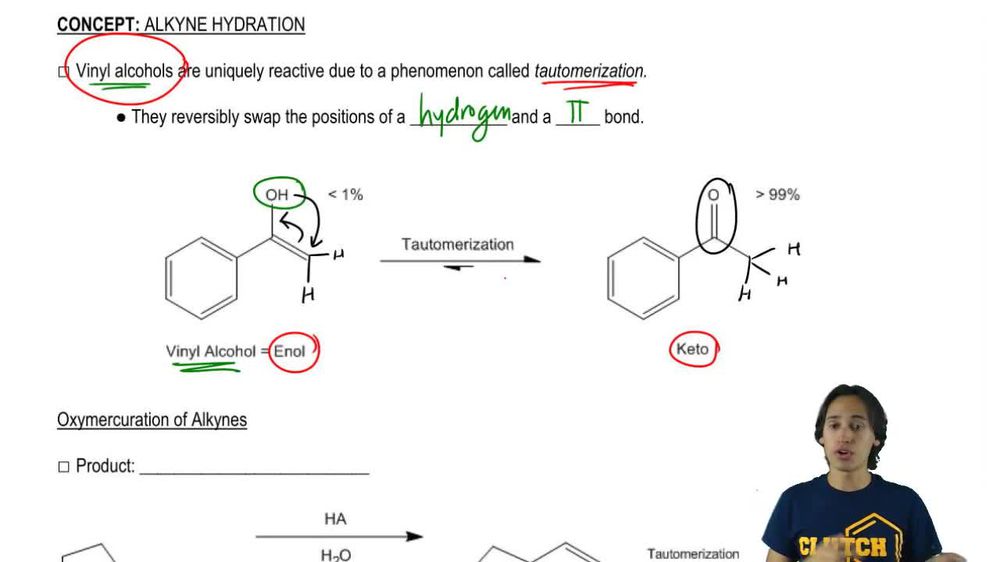
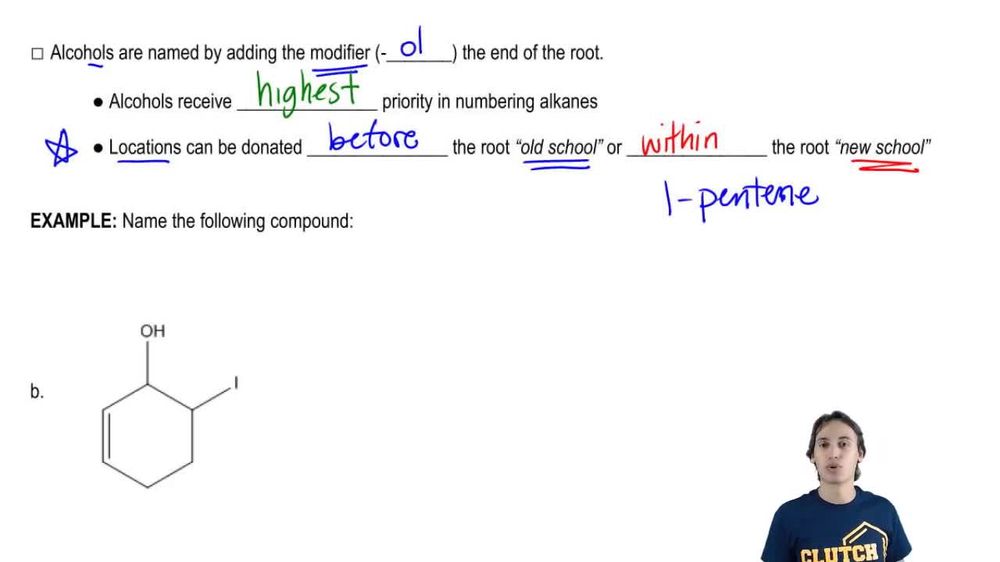
The hydration of three C5H10 alkene isomers can give 2-methylbutan-2-ol. Draw them.
Verified step by step guidance
1
Identify the target product, 2-methylbutan-2-ol, and recognize that it is a tertiary alcohol. This means the hydroxyl group (-OH) is attached to a carbon atom that is bonded to three other carbon atoms.
Understand that the hydration of an alkene involves the addition of water (H₂O) across the double bond, following Markovnikov's rule. This rule states that the -OH group will attach to the more substituted carbon of the double bond.
Determine the possible structures of C₅H₁₀ alkenes that can lead to 2-methylbutan-2-ol. These alkenes must have a double bond positioned such that, upon hydration, the -OH group attaches to the tertiary carbon in the final product.
Draw the first isomer: 2-methylbut-2-ene. This structure has the double bond between the second and third carbons, and the methyl group is attached to the second carbon. Hydration of this alkene will directly yield 2-methylbutan-2-ol.
Draw the second and third isomers: 3-methylbut-1-ene and 2-methylbut-1-ene. In these cases, the double bond is positioned differently, but hydration will still lead to the formation of 2-methylbutan-2-ol due to carbocation rearrangement during the reaction mechanism.
Verified video answer for a similar problem:
This video solution was recommended by our tutors as helpful for the problem above
Video duration:
3m
Play a video:
0 Comments
Key Concepts
Here are the essential concepts you must grasp in order to answer the question correctly.
Alkene Isomers
Alkene isomers are compounds that have the same molecular formula but differ in the arrangement of their carbon atoms or the position of their double bonds. In the case of C₅H₁₀, there are several structural isomers, including those with different branching patterns. Understanding these isomers is crucial for predicting the products of reactions such as hydration.
Hydration is a chemical reaction where water is added to an alkene, resulting in the formation of an alcohol. This reaction typically follows Markovnikov's rule, where the hydrogen atom from water adds to the carbon with the most hydrogen substituents, leading to the formation of more stable carbocation intermediates. Recognizing how hydration affects the structure of the resulting alcohol is essential for this question.
2-Methylbutan-2-ol is a specific alcohol that can be formed from the hydration of certain C₅H₁₀ alkene isomers. It features a secondary alcohol structure with a methyl group on the second carbon of a butane chain. Identifying the alkene isomers that can yield this particular alcohol through hydration is key to solving the question.

 3:19 minutes
 Verified step by step guidance
 01:10
01:10