Show how each of the following compounds can be synthesized from benzene: d. anisole
Verified step by step guidance
1
Step 1: Begin with benzene as the starting material. Benzene is an aromatic compound with a six-membered ring and alternating double bonds.
Step 2: Perform a Friedel-Crafts alkylation reaction to introduce a methyl group onto the benzene ring. Use methyl chloride (CH3Cl) as the alkylating agent and aluminum chloride (AlCl3) as the catalyst. This will yield toluene (methylbenzene).
Step 3: Oxidize the methyl group in toluene to form benzoic acid. This can be achieved using a strong oxidizing agent such as potassium permanganate (KMnO4) under acidic or basic conditions.
Step 4: Convert benzoic acid to phenol by first reducing it to benzaldehyde using a reducing agent like lithium aluminum hydride (LiAlH4), followed by oxidation to phenol using a reagent such as copper (II) oxide (CuO).
Step 5: Methylate phenol to form anisole. Use dimethyl sulfate (CH3OSO2CH3) or methyl iodide (CH3I) in the presence of a base like sodium hydroxide (NaOH) to introduce the methoxy group (-OCH3) onto the benzene ring.
Verified video answer for a similar problem:
This video solution was recommended by our tutors as helpful for the problem above
Video duration:
4m
Play a video:
0 Comments
Key Concepts
Here are the essential concepts you must grasp in order to answer the question correctly.
Electrophilic Aromatic Substitution (EAS)
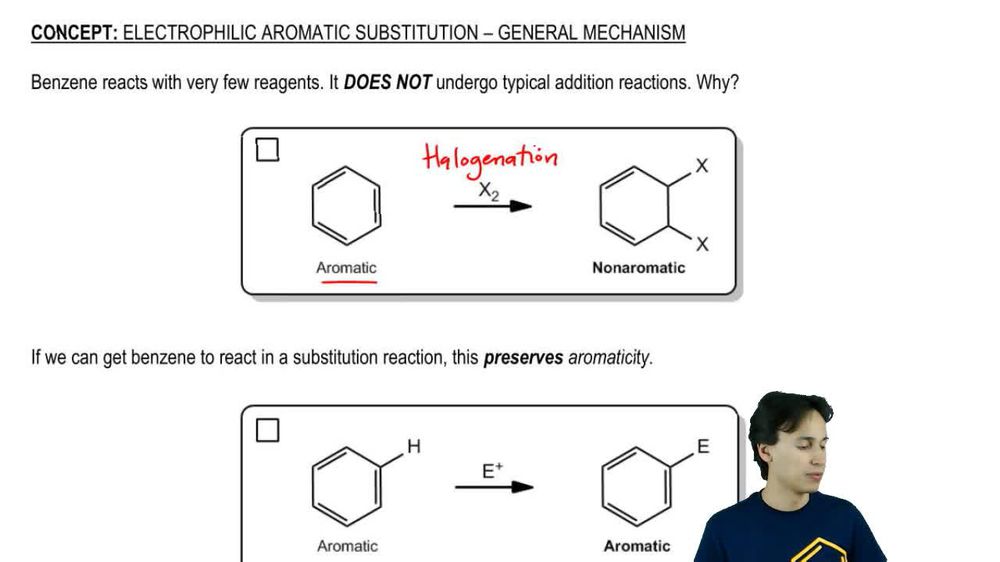
Electrophilic Aromatic Substitution is a fundamental reaction in organic chemistry where an electrophile replaces a hydrogen atom on an aromatic ring. This process is crucial for synthesizing various aromatic compounds, including anisole from benzene. The reaction typically involves the generation of a highly reactive electrophile that can attack the electron-rich benzene ring, leading to the formation of a substituted product.
The choice of reagents is essential in EAS reactions. For synthesizing anisole from benzene, a common approach is to use an alkylating agent like an alkyl halide (e.g., ethyl bromide) in the presence of a strong base (like sodium hydroxide) to facilitate the substitution. Understanding the role of these reagents helps predict the outcome of the reaction and the nature of the substituent introduced onto the aromatic ring.
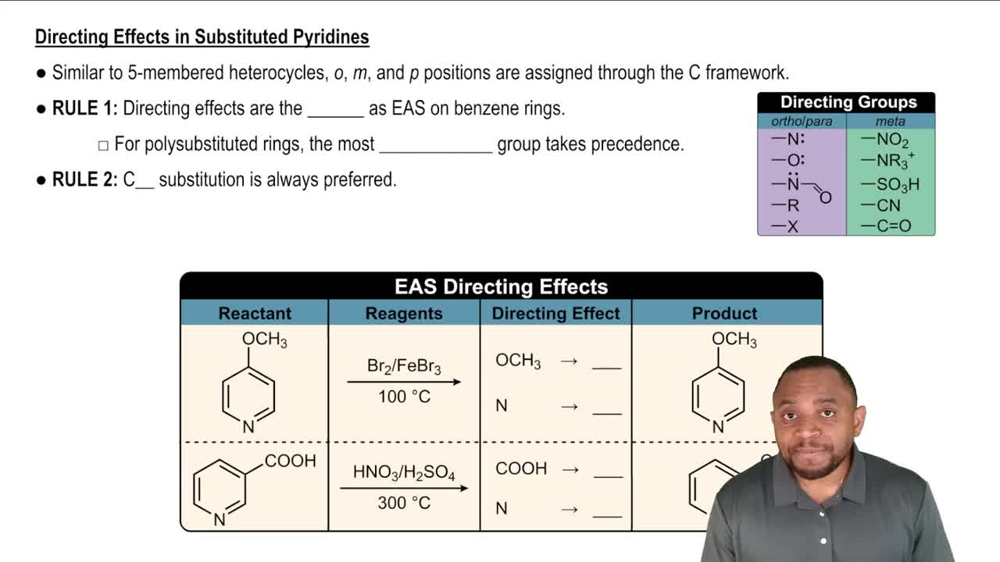
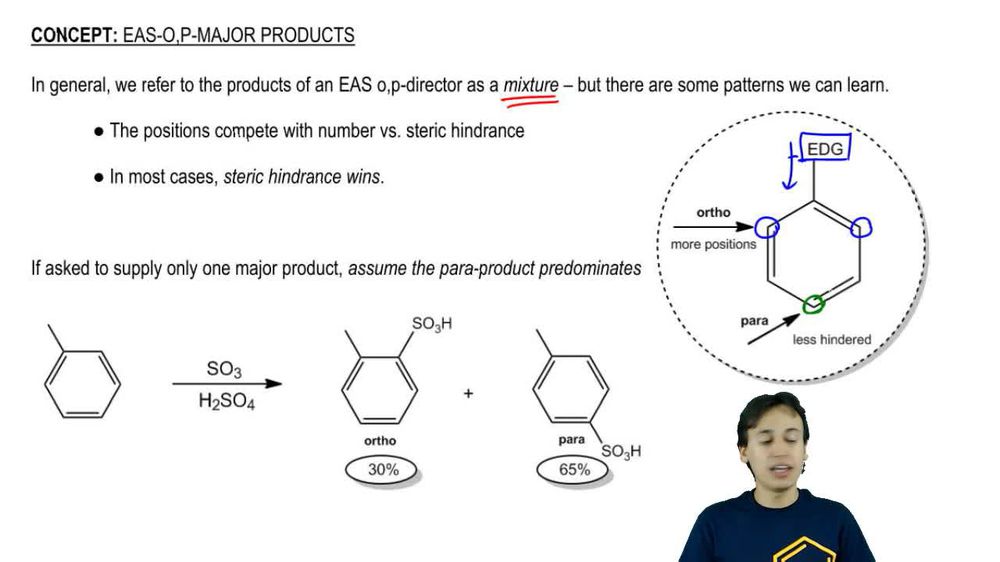
In EAS reactions, substituents on the aromatic ring can influence the position where new substituents are added. Anisole, with its methoxy group (-OCH2CH3), is an ortho/para director, meaning that new substituents will preferentially attach at the ortho or para positions relative to the existing substituent. This concept is vital for understanding the regioselectivity of the synthesis and predicting the structure of the final product.

 4:54 minutes
 Verified step by step guidance
 03:07
03:07