Show how each of the following compounds can be synthesized from benzene: i. 1-phenyl-2-propanol
Verified step by step guidance
1
Step 1: Begin with benzene as the starting material. Perform a Friedel-Crafts alkylation reaction using 2-chloropropane and AlCl₃ as the catalyst. This introduces an isopropyl group onto the benzene ring, forming isopropylbenzene (cumene).
Step 2: Oxidize the isopropyl group on the benzene ring to form acetophenone (C₆H₅COCH₃). This can be achieved using an oxidizing agent such as chromic acid (H₂CrO₄).
Step 3: Reduce the carbonyl group in acetophenone to form 1-phenyl-2-propanol. Use a reducing agent such as sodium borohydride (NaBH₄) or lithium aluminum hydride (LiAlH₄) to convert the ketone group into a secondary alcohol.
Step 4: Purify the product using techniques such as recrystallization or distillation to isolate 1-phenyl-2-propanol.
Step 5: Confirm the structure of the synthesized compound using spectroscopic methods such as NMR or IR to ensure the correct product has been obtained.
Verified video answer for a similar problem:
This video solution was recommended by our tutors as helpful for the problem above
Video duration:
8m
Play a video:
0 Comments
Key Concepts
Here are the essential concepts you must grasp in order to answer the question correctly.
Electrophilic Aromatic Substitution (EAS)
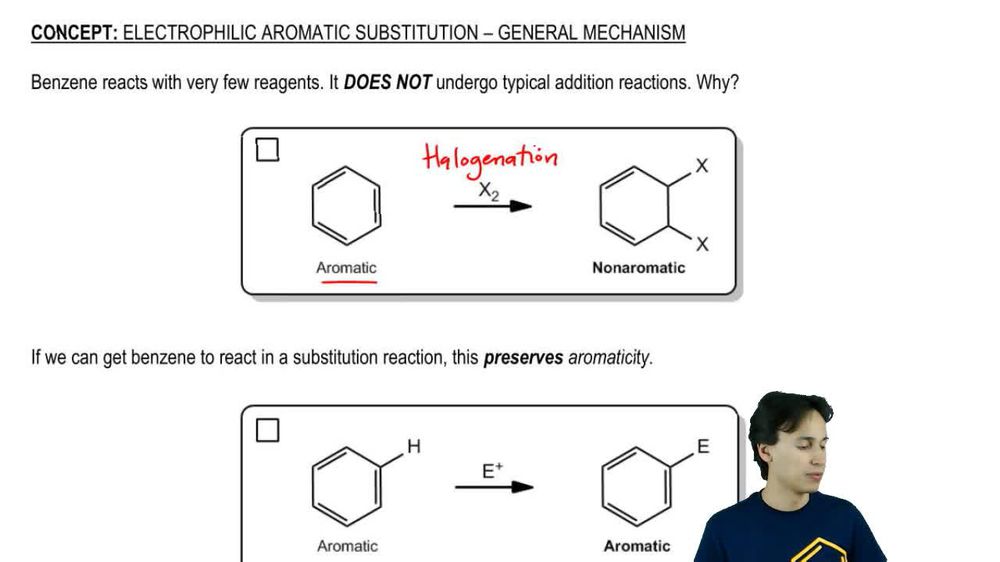
Electrophilic Aromatic Substitution is a fundamental reaction in organic chemistry where an electrophile replaces a hydrogen atom on an aromatic ring, such as benzene. This reaction is crucial for synthesizing various aromatic compounds, as it allows for the introduction of different functional groups onto the benzene ring, which can then be further modified to create complex molecules.
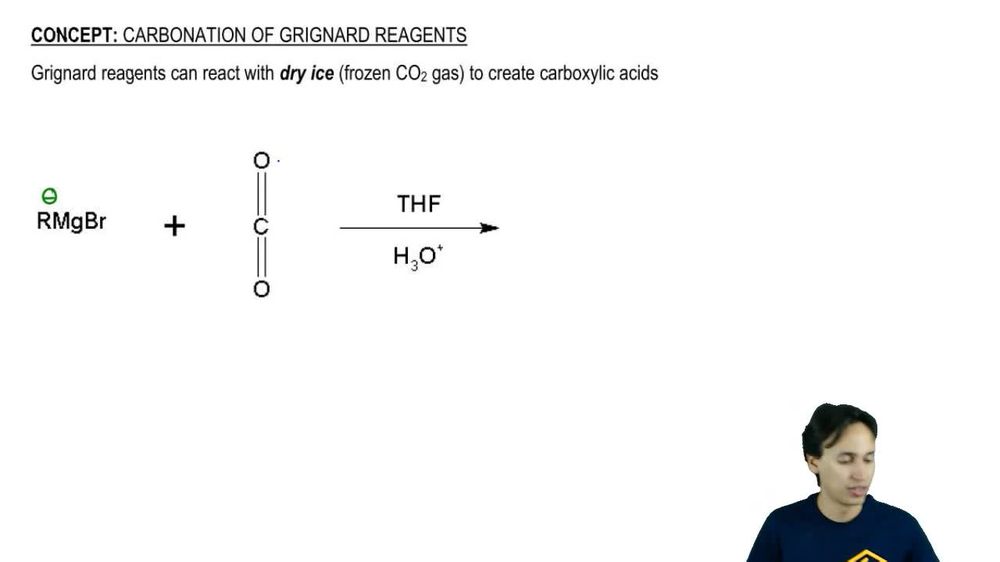
Grignard reagents are organomagnesium compounds that are highly reactive and used to form carbon-carbon bonds. They are synthesized by reacting magnesium with an alkyl or aryl halide. In the context of synthesizing 1-phenyl-2-propanol, a Grignard reagent can react with a carbonyl compound to produce an alcohol, demonstrating their utility in building larger organic molecules.
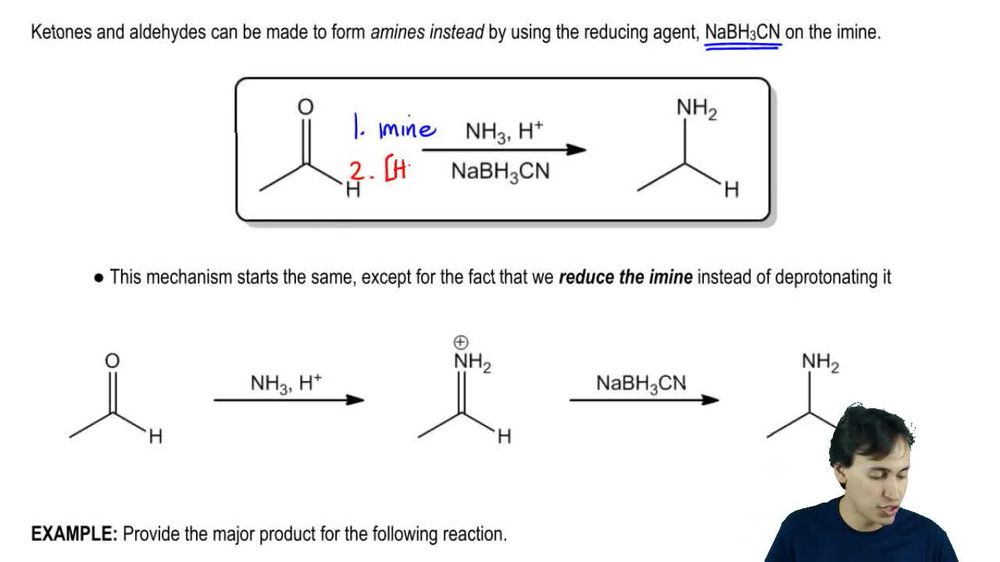
Reduction reactions involve the gain of electrons or the decrease in oxidation state of a molecule, often resulting in the formation of alcohols from carbonyl compounds. In the synthesis of 1-phenyl-2-propanol, a ketone or aldehyde intermediate can be reduced using reducing agents like lithium aluminum hydride (LiAlH4) or sodium borohydride (NaBH4) to yield the desired alcohol product.

 8:47 minutes
 Verified step by step guidance
 03:07
03:07