What aspect of the structure of the alkene does ozonolysis not tell you?
Verified step by step guidance
1
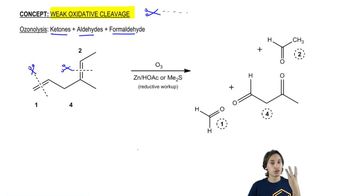
Ozonolysis is a reaction where an alkene is cleaved by ozone (O₃) to form carbonyl compounds (aldehydes or ketones). This reaction is useful for determining the positions of double bonds in an alkene.
When an alkene undergoes ozonolysis, the double bond is broken, and each carbon atom of the double bond is converted into a carbonyl group. The products provide information about the connectivity of the carbon atoms around the double bond.
However, ozonolysis does not provide information about the stereochemistry of the alkene. Specifically, it does not reveal whether the original alkene was in the cis (Z) or trans (E) configuration.
This limitation arises because the cleavage of the double bond during ozonolysis eliminates any stereochemical information. The products are the same regardless of whether the starting alkene was cis or trans.
To determine the stereochemistry of an alkene, other methods such as spectroscopic techniques (e.g., NMR) or reactions that preserve stereochemistry would need to be used.
Verified video answer for a similar problem:
This video solution was recommended by our tutors as helpful for the problem above
Video duration:
2m
Play a video:
0 Comments
Key Concepts
Here are the essential concepts you must grasp in order to answer the question correctly.
Alkene Structure
Alkenes are hydrocarbons characterized by at least one carbon-carbon double bond (C=C). This double bond influences their reactivity and geometry, leading to unique properties such as cis-trans isomerism. Understanding the specific arrangement of substituents around the double bond is crucial for predicting the outcomes of reactions involving alkenes.
Ozonolysis is a reaction involving the cleavage of carbon-carbon double bonds using ozone (O3), resulting in the formation of carbonyl compounds such as aldehydes and ketones. While this reaction provides information about the products formed from the alkene, it does not reveal the stereochemistry or the specific arrangement of substituents around the double bond, which are essential for understanding the alkene's structure.
Stereochemistry refers to the study of the spatial arrangement of atoms in molecules and how this affects their chemical behavior. In the context of alkenes, stereochemistry is important because the configuration of substituents around the double bond can lead to different isomers with distinct properties. Ozonolysis does not provide information about these configurations, which are critical for understanding the reactivity and characteristics of the alkene.