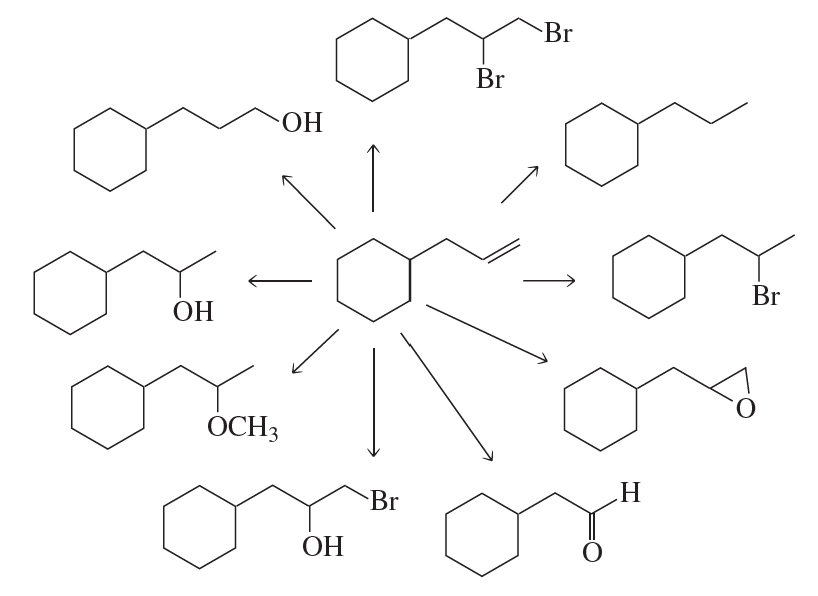
What reagents are needed to carry out the following syntheses?
Verified step by step guidance
1
Step 1: Analyze the first transformation (i). The starting material is an epoxide, and the product is an alkene. This suggests that the reaction involves the opening of the epoxide ring followed by elimination. A common reagent for this transformation is a strong base, such as sodium ethoxide (NaOEt), which can facilitate the elimination process.
Step 2: For the first transformation (i), the epoxide ring is opened under basic conditions, and the elimination occurs to form the double bond in the cyclopentyl group. Ensure the base is strong enough to deprotonate the intermediate and drive the elimination reaction.
Step 3: Analyze the second transformation (ii). The starting material is an alkene, and the product is a ketone. This suggests an oxidation reaction. A common reagent for this transformation is ozone (O₃) followed by a reductive workup, such as dimethyl sulfide (DMS) or zinc (Zn) with acetic acid.
Step 4: For the second transformation (ii), the alkene undergoes ozonolysis. The double bond is cleaved, and the resulting fragments are oxidized to form a ketone. Ensure the reductive workup is performed to avoid overoxidation.
Step 5: Verify the reagents and conditions for both transformations. For (i), use a strong base like NaOEt to open the epoxide and eliminate to form the alkene. For (ii), use ozone (O₃) followed by a reductive workup (e.g., DMS or Zn/AcOH) to cleave the alkene and form the ketone.
Verified video answer for a similar problem:
This video solution was recommended by our tutors as helpful for the problem above
Video duration:
3m
Play a video:
0 Comments
Key Concepts
Here are the essential concepts you must grasp in order to answer the question correctly.
Ozonolysis
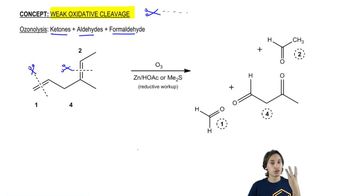
Ozonolysis is a reaction involving the cleavage of alkenes or alkynes using ozone (O3) to form carbonyl compounds, such as aldehydes and ketones. The process typically occurs in two steps: first, the alkene reacts with ozone to form a molozonide, which rearranges to form ozonide. The ozonide is then reduced, often using reagents like zinc and acetic acid or dimethyl sulfide, to yield the final carbonyl products.
The reagents commonly used in ozonolysis include ozone (O3) for the initial reaction and a reducing agent such as zinc (Zn) in acetic acid or dimethyl sulfide (DMS) for the second step. These reagents facilitate the conversion of the ozonide intermediate into stable carbonyl compounds, allowing for the identification and synthesis of specific products from the original alkene.
The mechanism of ozonolysis involves the electrophilic attack of ozone on the double bond of an alkene, leading to the formation of a cyclic molozonide. This intermediate undergoes rearrangement to form a more stable ozonide, which is then cleaved by the reducing agent to yield carbonyl compounds. Understanding this mechanism is crucial for predicting the products of ozonolysis and for designing synthetic pathways in organic chemistry.