Ch. 15 - Reactions of Carboxylic Acids and Carboxylic Acid Derivatives
Bruice - Organic Chemistry 8th Edition
Bruice8th EditionOrganic ChemistryISBN: 9780135213711Not the one you use?Change textbook
Chapter 16, Problem 36

Rank the following amides from greatest reactivity to least reactivity toward acid-catalyzed hydrolysis:
Structures of three amides labeled A, B, and C, for ranking reactivity toward acid-catalyzed hydrolysis.

Verified step by step guidance
1
Step 1: Understand the mechanism of acid-catalyzed hydrolysis of amides. Acid-catalyzed hydrolysis involves protonation of the amide carbonyl group, making it more electrophilic and susceptible to nucleophilic attack by water. The reactivity of the amide depends on the electronic effects of substituents attached to the nitrogen or the carbonyl group.
Step 2: Analyze the substituents on the amides. In structure A, the substituent is a cyclohexyl group, which is non-aromatic and does not have significant electron-withdrawing or donating effects. In structure B, the substituent is a nitro group (-NO₂) attached to a benzene ring, which is strongly electron-withdrawing and increases the electrophilicity of the carbonyl group. In structure C, the substituent is a methyl group (-CH₃) attached to a benzene ring, which is weakly electron-donating and decreases the electrophilicity of the carbonyl group.
Step 3: Rank the substituents based on their electronic effects. Electron-withdrawing groups like the nitro group in structure B increase the reactivity of the amide toward hydrolysis, while electron-donating groups like the methyl group in structure C decrease the reactivity. The cyclohexyl group in structure A has a neutral effect compared to the other two.
Step 4: Consider the resonance effects of the aromatic substituents. In structure B, the nitro group can withdraw electron density from the benzene ring through resonance, further increasing the electrophilicity of the carbonyl group. In structure C, the methyl group can donate electron density to the benzene ring through hyperconjugation, reducing the electrophilicity of the carbonyl group.
Step 5: Rank the amides from greatest reactivity to least reactivity based on the analysis. Structure B (with the nitro group) is the most reactive due to the strong electron-withdrawing effect. Structure A (with the cyclohexyl group) is moderately reactive due to the lack of significant electronic effects. Structure C (with the methyl group) is the least reactive due to the electron-donating effect.

Verified video answer for a similar problem:

This video solution was recommended by our tutors as helpful for the problem above.
Video duration:
7m
Was this helpful?

Key Concepts

Here are the essential concepts you must grasp in order to answer the question correctly.

Amide Reactivity

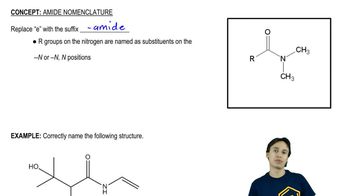
Amides are generally less reactive than other carbonyl compounds due to the resonance stabilization provided by the nitrogen atom. The lone pair of electrons on the nitrogen can delocalize into the carbonyl group, reducing the electrophilicity of the carbonyl carbon. Understanding the factors that influence amide reactivity, such as steric hindrance and electronic effects, is crucial for predicting their behavior in reactions like acid-catalyzed hydrolysis.
Recommended video:
Guided course
01:33
Amide Nomenclature

Electronic Effects

The electronic environment around the amide bond significantly affects its reactivity. Electron-withdrawing groups, such as nitro groups, increase the electrophilicity of the carbonyl carbon, making the amide more reactive. Conversely, electron-donating groups can decrease reactivity by stabilizing the carbonyl through resonance. Analyzing the substituents on the amides in the question helps determine their relative reactivity in hydrolysis.
Recommended video:
Guided course
04:29
Activity and Directing Effects

Acid-Catalyzed Hydrolysis

Acid-catalyzed hydrolysis of amides involves the addition of water to the carbonyl carbon, facilitated by the presence of an acid. The acid protonates the carbonyl oxygen, increasing the electrophilicity of the carbonyl carbon and making it more susceptible to nucleophilic attack by water. This process is essential for understanding how amides react under acidic conditions and allows for the ranking of their reactivity based on structural features.
Recommended video:
Guided course
03:09
Acid Catalyzed