Show how you would synthesize the following ethers in good yield from the indicated starting materials and any additional reagents needed. (a) cyclopentyl n-propyl ether from cyclopentanol and propan-1-ol
Verified step by step guidance
1
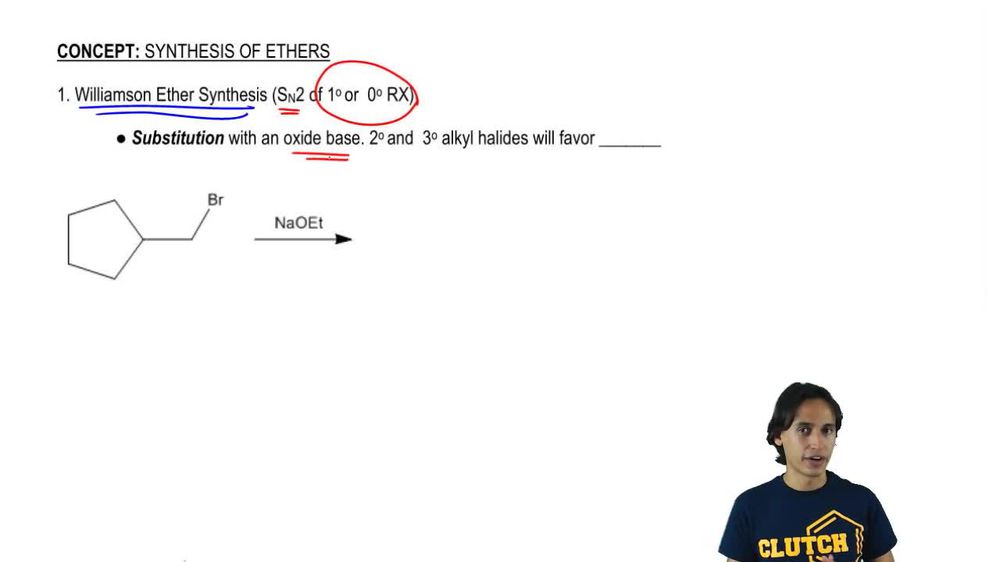
Step 1: Recognize that the synthesis of an ether can be achieved using the Williamson ether synthesis, which involves the reaction of an alkoxide ion with a primary alkyl halide.
Step 2: Convert cyclopentanol into cyclopentoxide by treating it with a strong base such as sodium hydride (NaH) or potassium hydroxide (KOH). This deprotonates the alcohol to form the alkoxide ion, cyclopentoxide.
Step 3: Prepare propyl bromide or propyl iodide from propan-1-ol by reacting it with a halogenating agent such as phosphorus tribromide (PBr₃) or thionyl chloride (SOCl₂) followed by substitution with sodium iodide (NaI) if needed.
Step 4: React the cyclopentoxide ion with the propyl halide in an SN2 reaction. This involves the nucleophilic attack of the cyclopentoxide on the carbon atom of the propyl halide, displacing the halide ion and forming cyclopentyl n-propyl ether.
Step 5: Purify the product using techniques such as distillation or extraction to isolate the desired ether in good yield.
Verified video answer for a similar problem:
This video solution was recommended by our tutors as helpful for the problem above
Video duration:
3m
Play a video:
0 Comments
Key Concepts
Here are the essential concepts you must grasp in order to answer the question correctly.
Ethers and Their Synthesis
Ethers are organic compounds characterized by an oxygen atom connected to two alkyl or aryl groups. They can be synthesized through various methods, including the Williamson ether synthesis, which involves the nucleophilic substitution of an alkoxide ion with a primary alkyl halide. Understanding the structure and reactivity of ethers is crucial for planning their synthesis.
Nucleophilic substitution reactions are fundamental in organic chemistry, where a nucleophile attacks an electrophile, resulting in the replacement of a leaving group. In the context of ether synthesis, the nucleophile is typically an alkoxide ion derived from an alcohol, and the electrophile is a suitable alkyl halide. Recognizing the mechanisms (SN1 or SN2) involved is essential for predicting reaction outcomes.
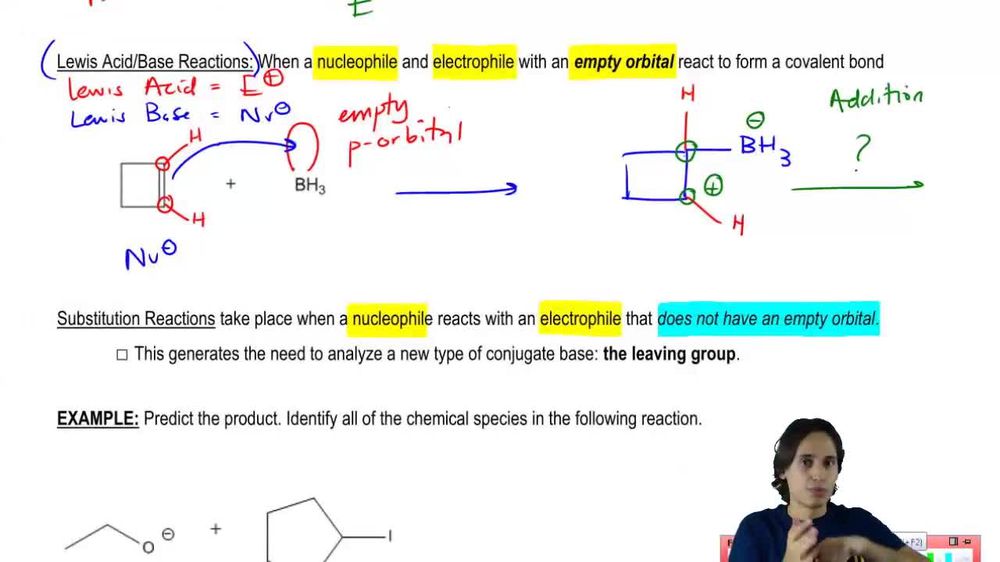
Nucleophiles and Electrophiles can react in Substitution Reactions.
Reactivity of Alcohols
Alcohols can act as both nucleophiles and electrophiles in organic reactions. In the synthesis of ethers, alcohols can be converted into alkoxide ions through deprotonation, which then participate in nucleophilic substitution. Additionally, the choice of alcohols (primary vs. secondary) affects the reaction pathway and yield, making it important to consider their structure when planning synthesis.