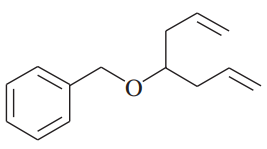
Both LiAlH4 and Grignard reagents react with carbonyl compounds to give alkoxide ion intermediates (that become protonated in an aqueous workup). Those alkoxides can react with 1° or methyl alkyl halides or tosylates to give ethers. Show how the following ethers can be formed in this two-step process. As starting materials you may use any reactants containing 7 carbons or fewer. (a)
Verified step by step guidance
1
Step 1: Analyze the target ether structure. The ether shown has a phenyl group (benzene ring) attached to one side of the oxygen atom and an allyl group (CH2=CH-CH2-) attached to the other side. This suggests that the synthesis involves combining a phenol derivative and an allyl halide or tosylate.
Step 2: Choose the starting materials. To form the phenyl group attached to the oxygen, start with phenol (C6H5OH). For the allyl group, use allyl bromide (CH2=CH-CH2Br) or allyl tosylate as the alkylating agent.
Step 3: Perform the first step of the reaction. React phenol with a base, such as NaH or KOH, to deprotonate the hydroxyl group and form the phenoxide ion (C6H5O⁻). This step prepares the phenol for nucleophilic substitution.
Step 4: Perform the second step of the reaction. React the phenoxide ion with allyl bromide or allyl tosylate in an SN2 reaction. The phenoxide ion acts as a nucleophile, attacking the electrophilic carbon in the allyl halide or tosylate, displacing the leaving group (Br⁻ or tosylate) and forming the ether bond.
Step 5: Verify the product. The reaction yields the desired ether, where the phenyl group is bonded to the oxygen atom, and the allyl group is bonded to the other side of the oxygen atom. Ensure that the starting materials used contain 7 carbons or fewer, as specified in the problem.
Verified video answer for a similar problem:
This video solution was recommended by our tutors as helpful for the problem above
Video duration:
7m
Play a video:
0 Comments
Key Concepts
Here are the essential concepts you must grasp in order to answer the question correctly.
Reduction of Carbonyl Compounds
LiAlH4 (Lithium aluminum hydride) and Grignard reagents are powerful reducing agents that react with carbonyl compounds to form alkoxide intermediates. In this process, the carbonyl group (C=O) is converted to an alcohol (R-OH) by the addition of hydride ions, which is crucial for the subsequent formation of ethers.
Once alkoxide ions are formed from the reduction of carbonyl compounds, they can react with primary (1°) or methyl alkyl halides or tosylates. This nucleophilic substitution reaction leads to the formation of ethers, where the alkoxide acts as a nucleophile, attacking the electrophilic carbon of the alkyl halide.
After the reaction involving alkoxides, an aqueous workup is typically performed to protonate the alkoxide, converting it into an alcohol. This step is essential for isolating the desired ether product, as it ensures that the reaction conditions are neutralized and any unreacted reagents are removed.