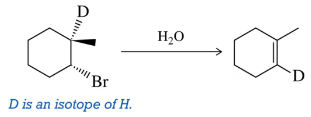
Provide a mechanism for the following E1 reactions. (c)
Verified step by step guidance
1
Step 1: Identify the reaction type. This is an E1 elimination reaction, which proceeds via a two-step mechanism involving the formation of a carbocation intermediate.
Step 2: Analyze the substrate. The starting molecule is a cyclohexane derivative with a bromine atom (Br) as the leaving group and a deuterium (D, an isotope of hydrogen) attached to the same carbon. The reaction occurs in the presence of water (H2O), which acts as a polar protic solvent to stabilize the carbocation intermediate.
Step 3: First step of the mechanism - Formation of the carbocation. The bromine atom leaves the molecule, taking its bonding electrons with it, resulting in the formation of a carbocation intermediate at the carbon where Br was attached. This step is the rate-determining step of the E1 mechanism.
Step 4: Second step of the mechanism - Elimination of a proton. A proton (H or D) is removed from a β-carbon (a carbon adjacent to the carbocation). The water molecule acts as a base and abstracts the proton, leading to the formation of a double bond between the α-carbon (the carbocation carbon) and the β-carbon. In this case, the deuterium (D) remains attached to the molecule, and the double bond forms in the ring structure.
Step 5: Final product. The result is a cyclohexene derivative with a double bond in the ring and the deuterium (D) still attached to the original position. The stereochemistry of D is retained because it is not involved in the elimination process.
Verified video answer for a similar problem:
This video solution was recommended by our tutors as helpful for the problem above
Play a video:
0 Comments
Key Concepts
Here are the essential concepts you must grasp in order to answer the question correctly.
E1 Reaction Mechanism
The E1 reaction mechanism is a type of elimination reaction that involves two steps: the formation of a carbocation intermediate followed by the loss of a proton to form a double bond. This mechanism typically occurs in substrates that can stabilize the carbocation, such as tertiary alkyl halides. The rate of the reaction depends only on the concentration of the substrate, making it unimolecular.
Carbocation stability is crucial in E1 reactions, as the formation of a stable carbocation intermediate is essential for the reaction to proceed. Carbocations are stabilized by hyperconjugation and inductive effects from adjacent alkyl groups. Tertiary carbocations are the most stable due to the presence of three alkyl groups, while primary carbocations are the least stable and less likely to form in E1 reactions.
Regioselectivity refers to the preference of a chemical reaction to yield one structural isomer over others. In E1 reactions, the formation of the double bond can lead to different alkene products depending on the orientation of the leaving group and the hydrogen being removed. Understanding regioselectivity helps predict the major product in elimination reactions, often guided by Zaitsev's rule, which states that the more substituted alkene is typically favored.

 Verified step by step guidance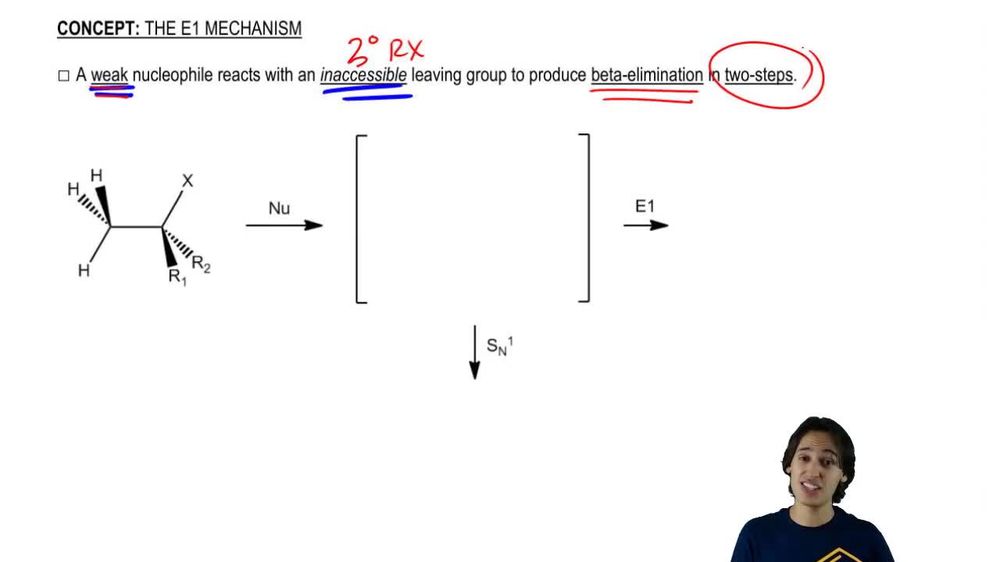
 08:09
08:09