Predict the product of the following rearrangement-prone E1 eliminations. (c)
Verified step by step guidance
1
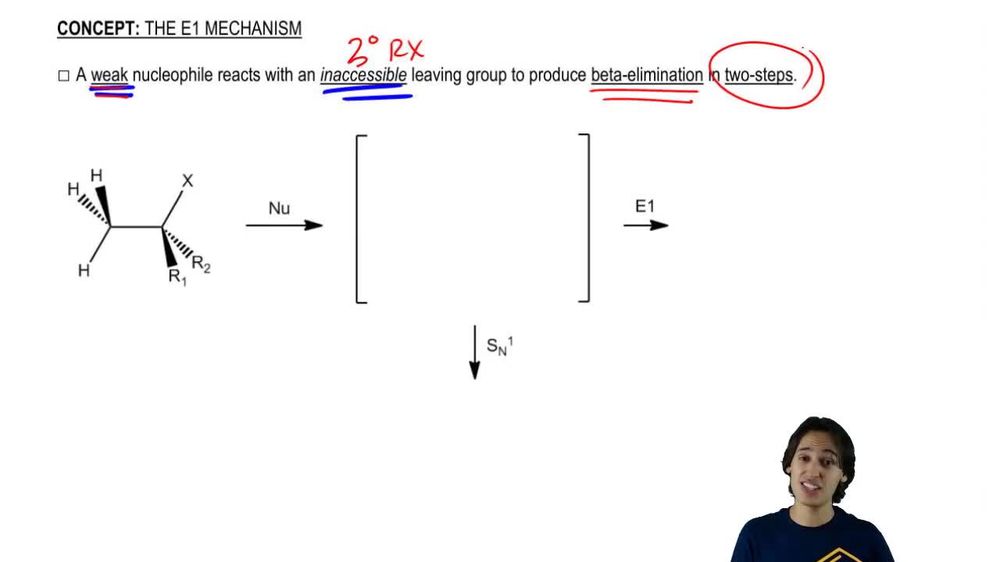
Step 1: Recognize that the reaction is an E1 elimination. E1 eliminations proceed via a two-step mechanism: (1) formation of a carbocation intermediate after the leaving group departs, and (2) elimination of a proton to form the double bond.
Step 2: Identify the leaving group. In this case, the leaving group is the chlorine (Cl) atom attached to the carbon. Heat and the alcohol solvent will promote the departure of the Cl, forming a carbocation intermediate.
Step 3: Analyze the carbocation intermediate for rearrangement. The initial carbocation forms at the carbon bonded to the chlorine. However, carbocations can rearrange to form a more stable carbocation. Here, a hydride shift from the adjacent tertiary carbon (bearing the CH3 groups) will occur, resulting in a more stable tertiary carbocation.
Step 4: Determine the site of elimination. After the carbocation rearrangement, a proton will be eliminated from a β-carbon (a carbon adjacent to the carbocation) to form the most stable alkene. The elimination will favor the formation of the more substituted alkene due to Zaitsev's rule.
Step 5: Draw the final product. The double bond will form between the carbocation carbon and the β-carbon that lost the proton, resulting in the most stable alkene product. Ensure the phenyl group (Ph) and other substituents are correctly positioned in the structure.
Verified video answer for a similar problem:
This video solution was recommended by our tutors as helpful for the problem above
Video duration:
3m
Play a video:
0 Comments
Key Concepts
Here are the essential concepts you must grasp in order to answer the question correctly.
E1 Mechanism
The E1 mechanism is a type of elimination reaction that involves two steps: the formation of a carbocation intermediate followed by the loss of a leaving group to form a double bond. This mechanism is favored in polar protic solvents and typically occurs with tertiary or some secondary substrates due to their ability to stabilize the carbocation. Understanding the E1 mechanism is crucial for predicting the products of rearrangement-prone eliminations.
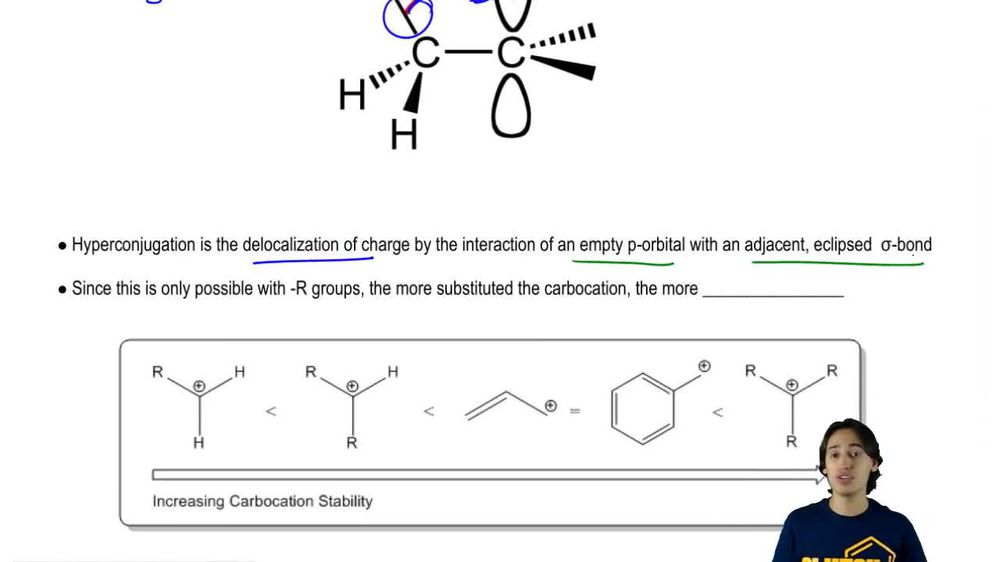
Carbocation stability is a key factor in determining the outcome of E1 reactions. Tertiary carbocations are more stable than secondary or primary ones due to hyperconjugation and inductive effects from surrounding alkyl groups. The stability of the carbocation can influence whether rearrangements occur, as more stable carbocations are favored, leading to different product distributions in elimination reactions.
Rearrangement in organic reactions refers to the process where a molecule undergoes a structural change, often to form a more stable product. In the context of E1 eliminations, carbocations may rearrange to form more stable structures before the elimination step occurs. Recognizing potential rearrangements is essential for accurately predicting the final products of the reaction.

 3:27 minutes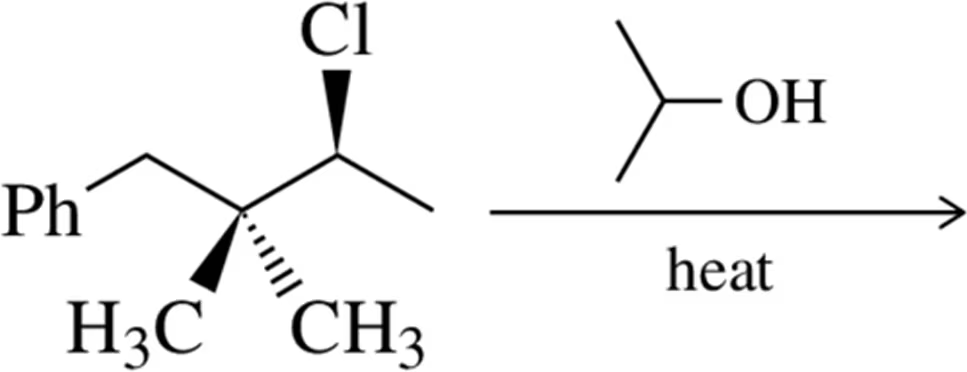
 Verified step by step guidance
 08:09
08:09