Draw the structures of the following carboxylic acids. (e) trans-2-methylcyclohexanecarboxylic acid (f) 2,3-dimethylfumaric acid (g) m-chlorobenzoic acid (h) 3-methylphthalic acid
Verified step by step guidance
1
Step 1: Understand the structure of a carboxylic acid. A carboxylic acid contains a carboxyl group (-COOH) attached to a carbon atom. This functional group is the defining feature of carboxylic acids.
Step 2: For trans-2-methylcyclohexanecarboxylic acid, start with a cyclohexane ring. Add a carboxyl group (-COOH) to one carbon atom of the ring. Then, add a methyl group (-CH₃) to the second carbon atom in a trans configuration relative to the carboxyl group. Ensure the substituents are on opposite sides of the ring plane.
Step 3: For 2,3-dimethylfumaric acid, begin with the structure of fumaric acid, which is a trans isomer of butenedioic acid. Add two methyl groups (-CH₃), one on the second carbon and one on the third carbon of the double bond. Ensure the double bond remains in the trans configuration, with the carboxyl groups (-COOH) on opposite sides of the double bond.
Step 4: For m-chlorobenzoic acid, start with the benzene ring as the base structure. Attach a carboxyl group (-COOH) to one carbon atom of the benzene ring. Then, add a chlorine atom (Cl) to the meta position relative to the carboxyl group. The meta position means there is one carbon atom separating the carboxyl group and the chlorine atom on the ring.
Step 5: For 3-methylphthalic acid, begin with the structure of phthalic acid, which is a benzene ring with two carboxyl groups (-COOH) in the ortho position (adjacent to each other). Add a methyl group (-CH₃) to the third carbon atom of the benzene ring, counting from one of the carboxyl groups. Ensure the positions of all substituents are clearly indicated.
Verified video answer for a similar problem:
This video solution was recommended by our tutors as helpful for the problem above
Video duration:
5m
Play a video:
0 Comments
Key Concepts
Here are the essential concepts you must grasp in order to answer the question correctly.
Carboxylic Acids
Carboxylic acids are organic compounds characterized by the presence of one or more carboxyl groups (-COOH). They are known for their acidic properties due to the ability of the carboxyl group to donate a proton (H+). Understanding the structure and functional group of carboxylic acids is essential for drawing their chemical structures accurately.
Cycloalkanes are saturated hydrocarbons with carbon atoms arranged in a ring structure. When substituents, such as methyl groups, are attached to the cycloalkane, their positions can affect the compound's properties and nomenclature. Recognizing how to depict these substituents in relation to the carboxylic acid group is crucial for accurately representing the structures requested in the question.
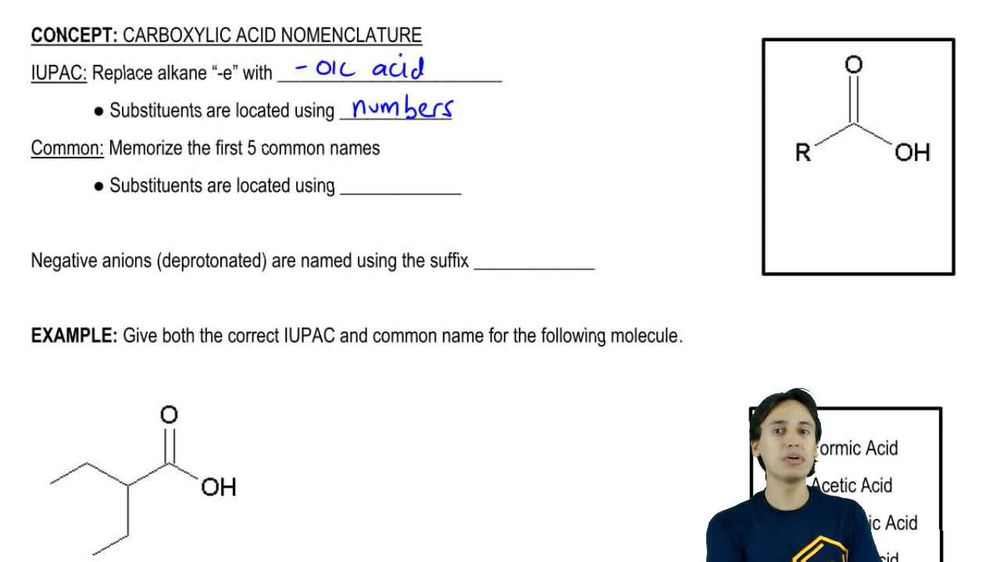
The nomenclature of organic compounds follows specific rules set by the International Union of Pure and Applied Chemistry (IUPAC). This includes naming conventions for identifying the longest carbon chain, the position of functional groups, and the naming of substituents. Familiarity with these rules is necessary to interpret the names of the acids provided and to draw their correct structures.