How many sets of equivalent hydrogens are in each molecule shown? (a)
Verified step by step guidance
1
Identify the molecular structure of the given molecule. Look for symmetry and identical groups within the molecule.
Examine the molecule for any planes of symmetry or rotational symmetry. Equivalent hydrogens are those that are indistinguishable by symmetry.
Consider the chemical environment of each hydrogen atom. Hydrogens in the same chemical environment are equivalent.
Group hydrogens that are in identical environments, such as those attached to the same type of carbon or in similar positions relative to functional groups.
Count the number of distinct groups of equivalent hydrogens. Each group represents a set of equivalent hydrogens.
Verified video answer for a similar problem:
This video solution was recommended by our tutors as helpful for the problem above
Video duration:
1m
Play a video:
0 Comments
Key Concepts
Here are the essential concepts you must grasp in order to answer the question correctly.
Equivalent Hydrogens
Equivalent hydrogens are hydrogen atoms in a molecule that are in identical chemical environments. They exhibit the same chemical shift in NMR spectroscopy because they are indistinguishable in terms of their connectivity and spatial arrangement. Identifying equivalent hydrogens is crucial for understanding molecular symmetry and predicting NMR spectra.
The chemical environment of a hydrogen atom refers to the surrounding atoms and the electronic structure that influence its chemical behavior and properties. Factors such as nearby electronegative atoms, hybridization, and steric effects can alter the chemical environment, making hydrogens non-equivalent. Recognizing these environments helps in determining equivalency among hydrogens.
Chemical Reactions of Phosphate Anhydrides Concept 1
NMR Spectroscopy
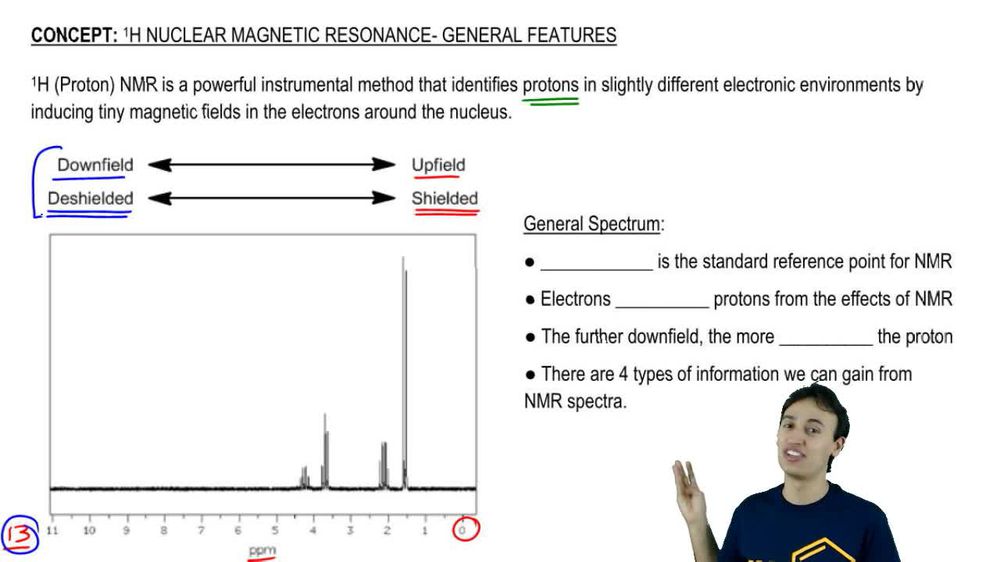
Nuclear Magnetic Resonance (NMR) spectroscopy is a technique used to observe the local magnetic fields around atomic nuclei. In organic chemistry, it is primarily used to identify the number of sets of equivalent hydrogens in a molecule. Each set of equivalent hydrogens produces a distinct signal, allowing chemists to deduce structural information about the molecule.

 1:44 minutes
 Verified step by step guidance
 05:21
05:21