Draw an isomer of dichlorocyclopropane that gives an 1H NMR spectrum c. with three signals
Verified step by step guidance
1
Understand the problem: Dichlorocyclopropane is a cyclopropane ring with two chlorine atoms attached. The goal is to draw an isomer of this compound that results in three distinct signals in its 1H NMR spectrum. Each signal corresponds to a unique chemical environment for the hydrogen atoms.
Recall the concept of chemical equivalence in 1H NMR: Hydrogens in the same chemical environment produce the same signal. To achieve three signals, the isomer must have three distinct sets of hydrogens, each in a unique environment.
Consider the symmetry of the molecule: A symmetrical arrangement of the chlorine atoms will reduce the number of unique hydrogen environments. To achieve three signals, the isomer must have reduced symmetry, ensuring three distinct hydrogen environments.
Propose a structure: Place the two chlorine atoms on different carbons of the cyclopropane ring in a way that breaks symmetry. For example, one chlorine atom could be on one carbon, and the other chlorine atom could be on an adjacent carbon, but not in a symmetrical arrangement (e.g., cis or trans configuration).
Verify the structure: Analyze the proposed isomer to confirm that it has three distinct sets of hydrogens. Check the chemical environments of each hydrogen on the cyclopropane ring to ensure they are not equivalent due to symmetry or proximity to the chlorine atoms.
Verified video answer for a similar problem:
This video solution was recommended by our tutors as helpful for the problem above
Video duration:
8m
Play a video:
0 Comments
Key Concepts
Here are the essential concepts you must grasp in order to answer the question correctly.
Isomerism
Isomerism refers to the phenomenon where two or more compounds have the same molecular formula but different structural arrangements or spatial orientations. In the case of dichlorocyclopropane, isomers can differ in the position of the chlorine atoms on the cyclopropane ring, leading to distinct chemical properties and reactivity.
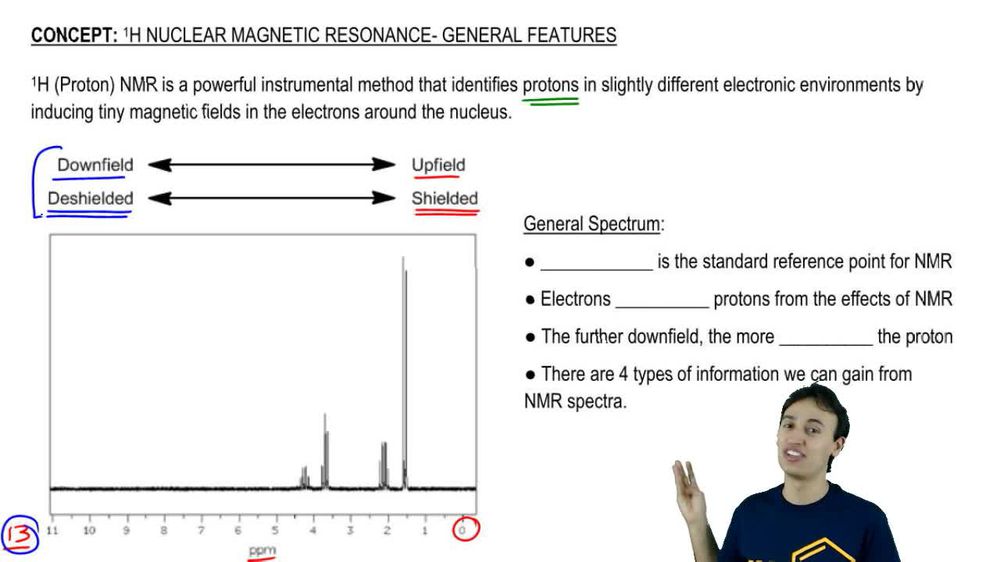
NMR spectroscopy is a powerful analytical technique used to determine the structure of organic compounds. It relies on the magnetic properties of certain nuclei, such as hydrogen, to provide information about the number of unique hydrogen environments in a molecule, which corresponds to the number of signals observed in the spectrum.
The chemical environment of a hydrogen atom in a molecule influences its NMR signal. Atoms bonded to different electronegative elements or in different structural contexts will resonate at different frequencies, resulting in distinct signals. For dichlorocyclopropane to exhibit three signals in its 1H NMR spectrum, it must have three unique hydrogen environments due to the arrangement of the chlorine substituents.

 8:28 minutes
 Verified step by step guidance
 06:47
06:47