Draw the signal for the following multiplicities. What is the ratio of peaks within each signal? (b) triplet
Verified step by step guidance
1
Understand that a triplet in NMR spectroscopy arises when a nucleus is coupled to two equivalent protons. This results in the splitting of the signal into three peaks.
Recall the n+1 rule, where n is the number of neighboring protons. For a triplet, n=2, so the signal is split into 3 peaks.
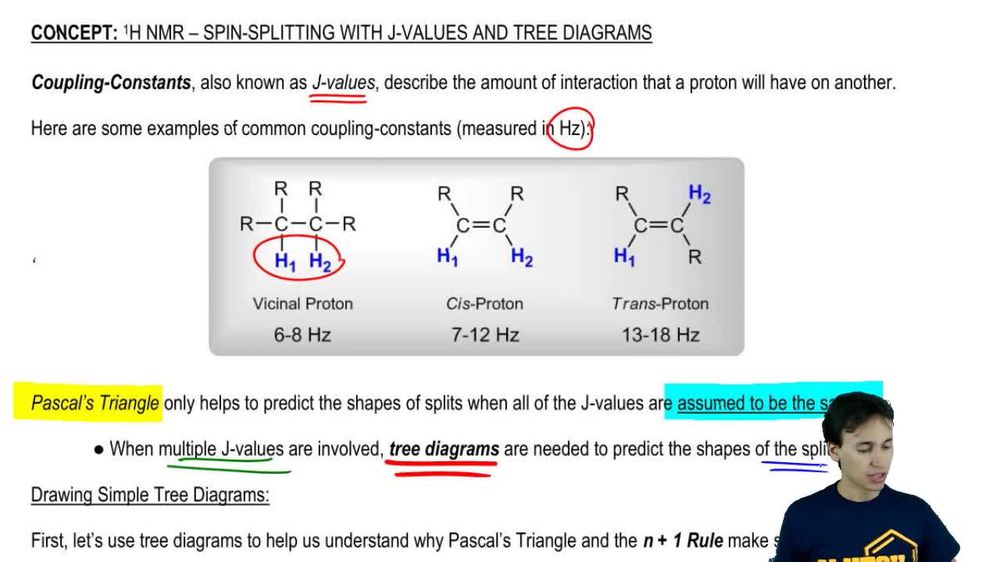
The ratio of the peaks in a triplet is determined by Pascal's triangle, which gives the coefficients for the binomial expansion. For a triplet, the ratio is 1:2:1.
Draw the triplet signal on an NMR spectrum. The central peak will be twice as tall as the outer peaks, reflecting the 1:2:1 ratio.
Label the peaks to indicate their relative intensities, ensuring the central peak is twice the height of the outer peaks, consistent with the 1:2:1 ratio.
Verified video answer for a similar problem:
This video solution was recommended by our tutors as helpful for the problem above
Video duration:
2m
Play a video:
0 Comments
Key Concepts
Here are the essential concepts you must grasp in order to answer the question correctly.
NMR Multiplicity
NMR multiplicity refers to the splitting of NMR signals into multiple peaks due to spin-spin coupling with neighboring non-equivalent protons. The number of peaks in a signal is determined by the n+1 rule, where n is the number of neighboring protons. Understanding multiplicity is crucial for interpreting NMR spectra and identifying molecular structures.
A triplet in NMR spectroscopy is a signal that splits into three peaks. This occurs when a proton is coupled with two equivalent neighboring protons. The intensity ratio of the peaks in a triplet is typically 1:2:1, reflecting the statistical likelihood of different spin states of the neighboring protons.
Pascal's Triangle is a mathematical tool used to determine the intensity ratios of peaks in NMR multiplets. Each row of the triangle corresponds to the coefficients of the binomial expansion, which represent the relative intensities of the peaks in a multiplet. For a triplet, the relevant row is 1:2:1, indicating the peak intensity distribution.

 2:02 minutes
 Verified step by step guidance
 10:06
10:06