Practice your electron-pushing skills by drawing a mechanism for the following SN1 reactions. (b)
Verified step by step guidance
1
Step 1: Understand the Sₙ1 reaction mechanism. Sₙ1 stands for 'substitution nucleophilic unimolecular,' which involves two steps: (1) the formation of a carbocation intermediate and (2) the nucleophilic attack on the carbocation.
Step 2: Identify the leaving group in the substrate molecule. The leaving group is typically a halide or another group that can stabilize the negative charge after leaving. Draw the substrate and show the bond breaking between the carbon and the leaving group.
Step 3: Illustrate the formation of the carbocation intermediate. After the leaving group departs, the carbon atom bonded to it becomes positively charged. Ensure you consider the stability of the carbocation (e.g., tertiary carbocations are more stable than secondary or primary).
Step 4: Show the nucleophilic attack. The nucleophile (e.g., water, hydroxide ion, or another electron-rich species) will attack the carbocation, forming a new bond. Use curved arrows to represent the movement of electrons during this step.
Step 5: If applicable, include any proton transfer or rearrangement steps to finalize the product. For example, if the nucleophile is water, a proton may need to be removed to yield the final neutral product. Ensure all charges are balanced and the product is correctly drawn.
Verified video answer for a similar problem:
This video solution was recommended by our tutors as helpful for the problem above
Video duration:
1m
Play a video:
0 Comments
Key Concepts
Here are the essential concepts you must grasp in order to answer the question correctly.
Sₙ1 Mechanism
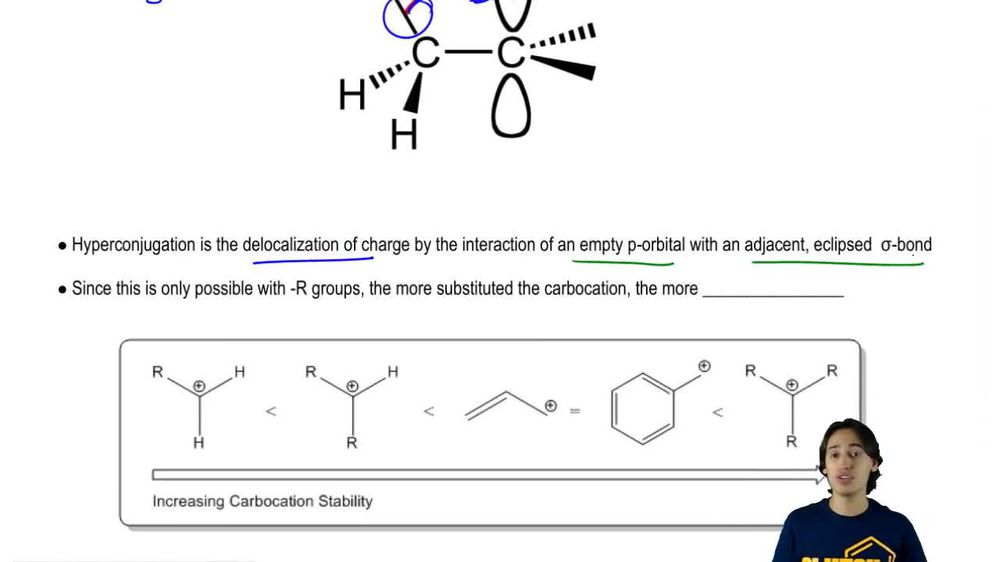
The Sₙ1 (substitution nucleophilic unimolecular) mechanism involves a two-step process where the rate-determining step is the formation of a carbocation intermediate. In this mechanism, the leaving group departs first, creating a positively charged carbocation, which is then attacked by a nucleophile. This mechanism is favored in tertiary substrates due to their ability to stabilize the carbocation.
Carbocation stability is crucial in Sₙ1 reactions, as more stable carbocations form more readily. Stability increases with the degree of substitution: tertiary > secondary > primary. Factors such as resonance and inductive effects also play a role in stabilizing carbocations, influencing the reaction pathway and rate.
Nucleophiles are species that donate an electron pair to form a chemical bond in a reaction. In Sₙ1 reactions, the nucleophile attacks the carbocation after its formation. The strength and nature of the nucleophile can significantly affect the reaction rate and product distribution, with stronger nucleophiles generally leading to faster reactions.