Hydration of alkynes (via oxymercuration) gives good yields of single compounds only with symmetrical or terminal alkynes. Show what the products would be from hydration of each compound. d. cyclodecyne
Verified step by step guidance
1
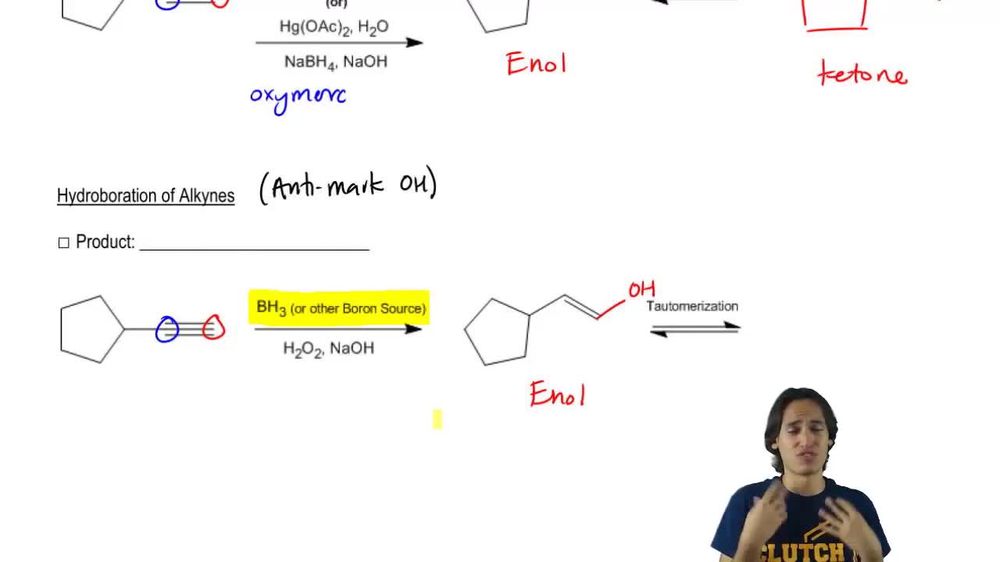
Identify the reaction type: The problem involves the hydration of an alkyne via oxymercuration. This reaction adds water (H₂O) across the triple bond of the alkyne in the presence of a mercuric ion catalyst (commonly HgSO₄) and an acid (H₂SO₄). The product is typically a ketone due to tautomerization of the enol intermediate.
Analyze the structure of cyclodecyne: Cyclodecyne is a cyclic alkyne with a triple bond in a 10-membered ring. Since it is an internal alkyne (not terminal), the hydration will not produce a single product but rather a mixture of ketones due to the lack of symmetry.
Determine the regioselectivity: In the hydration of internal alkynes, the addition of water is not regioselective because both carbons of the triple bond are equally substituted. This means the enol intermediate can form on either carbon of the triple bond, leading to two possible ketones after tautomerization.
Write the reaction mechanism: (1) The alkyne reacts with Hg²⁺ to form a mercurinium ion intermediate. (2) Water attacks the more electrophilic carbon of the triple bond, leading to the formation of an enol. (3) The enol undergoes acid-catalyzed tautomerization to form a ketone. Repeat this process for both possible enol intermediates to identify the two ketone products.
Draw the products: The two ketones will differ based on which carbon of the triple bond the water adds to. In cyclodecyne, this results in two ketones with the carbonyl group located at different positions within the 10-membered ring.
Verified video answer for a similar problem:
This video solution was recommended by our tutors as helpful for the problem above
Video duration:
2m
Play a video:
0 Comments
Key Concepts
Here are the essential concepts you must grasp in order to answer the question correctly.
Hydration of Alkynes
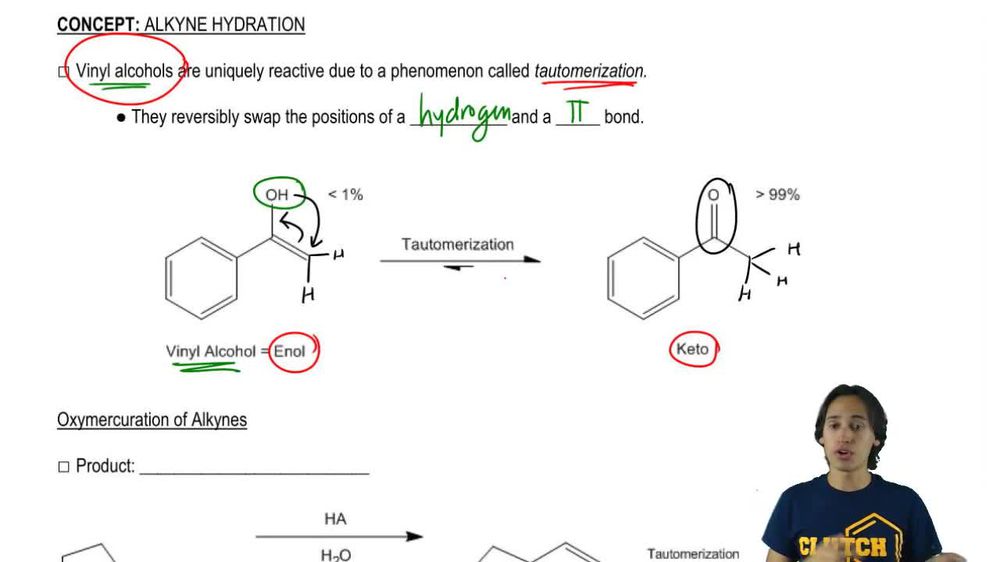
Hydration of alkynes involves the addition of water (H2O) across the triple bond of an alkyne, typically in the presence of an acid catalyst. This reaction can lead to the formation of enols, which can subsequently tautomerize to form ketones or aldehydes. The regioselectivity of this reaction is influenced by the structure of the alkyne, particularly whether it is symmetrical or terminal.
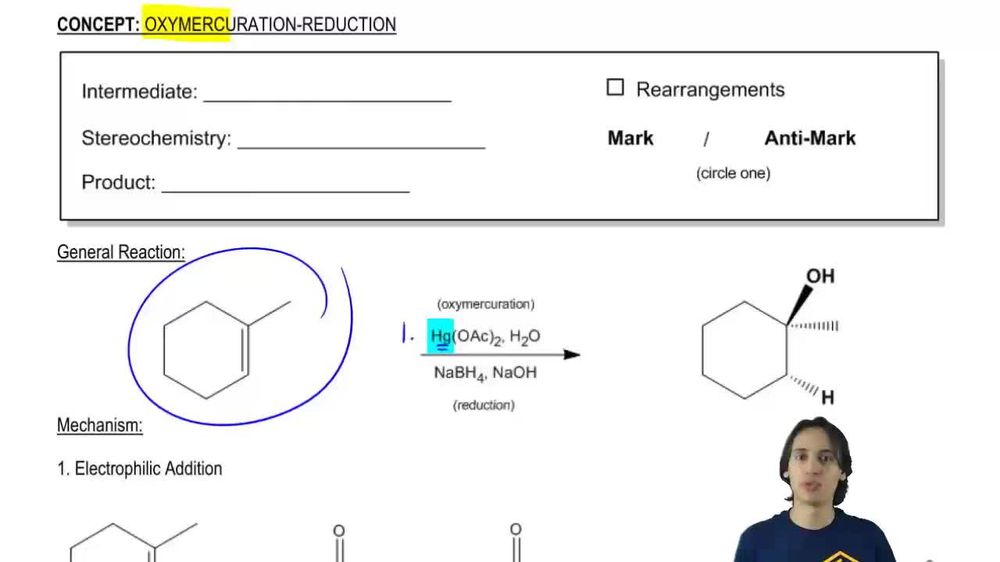
Oxymercuration-demercuration is a two-step reaction used to hydrate alkenes and alkynes. In the first step, mercuric acetate reacts with the alkyne to form a mercurial intermediate, which is then treated with water to yield an alcohol. The second step involves the reduction of the mercurial compound to remove mercury, resulting in the formation of the final alcohol product. This method is particularly useful for achieving Markovnikov selectivity.
Symmetrical alkynes have identical substituents on both ends of the triple bond, leading to a single product upon hydration. In contrast, terminal alkynes have a hydrogen atom at one end, allowing for the formation of different products depending on the regioselectivity of the reaction. Understanding the distinction between these types of alkynes is crucial for predicting the outcome of hydration reactions, especially in terms of product distribution.

 2:20 minutes
 Verified step by step guidance
 09:11
09:11