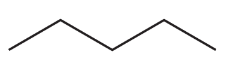
How can the following compounds be prepared using ethyne as the starting material? f.
Verified step by step guidance
1
Step 1: Begin with ethyne (C≡CH), which is a simple alkyne. Ethyne can undergo reactions to form longer carbon chains. The first step is to perform a reaction with sodium amide (NaNH₂) to generate the acetylide ion (C≡C⁻). This ion is highly nucleophilic and can be used for chain elongation.
Step 2: React the acetylide ion with an alkyl halide, such as ethyl bromide (CH₃CH₂Br), in an SN2 reaction. This will result in the formation of a new carbon-carbon bond, yielding a terminal alkyne (CH≡C-CH₂CH₃).
Step 3: Perform a hydrogenation reaction using Lindlar's catalyst (Pd/BaSO₄, quinoline) to partially reduce the alkyne to a cis-alkene (CH₂=CH-CH₂CH₃). This step is crucial for controlling the stereochemistry of the intermediate.
Step 4: Carry out a hydroboration-oxidation reaction using BH₃·THF followed by H₂O₂/NaOH. This converts the alkene into an alcohol (CH₃CH(OH)CH₂CH₃).
Step 5: Finally, perform a dehydration reaction using concentrated H₂SO₄ or POCl₃ to remove water and form the desired alkane structure (CH₃CH₂CH₂CH₃). This completes the synthesis of the target compound starting from ethyne.
Verified video answer for a similar problem:
This video solution was recommended by our tutors as helpful for the problem above
Video duration:
3m
Play a video:
0 Comments
Key Concepts
Here are the essential concepts you must grasp in order to answer the question correctly.
Ethyne as a Building Block
Ethyne, also known as acetylene, is a simple alkyne that serves as a versatile building block in organic synthesis. Its triple bond allows for various reactions, including addition reactions with electrophiles, which can lead to the formation of more complex molecules. Understanding how to manipulate ethyne's reactivity is crucial for synthesizing target compounds.
Alkynes undergo a variety of chemical reactions, including hydrogenation, halogenation, and hydroboration. These reactions can modify the triple bond to form double bonds or single bonds, allowing for the construction of different functional groups. Familiarity with these reaction types is essential for predicting the pathways to synthesize desired compounds from ethyne.
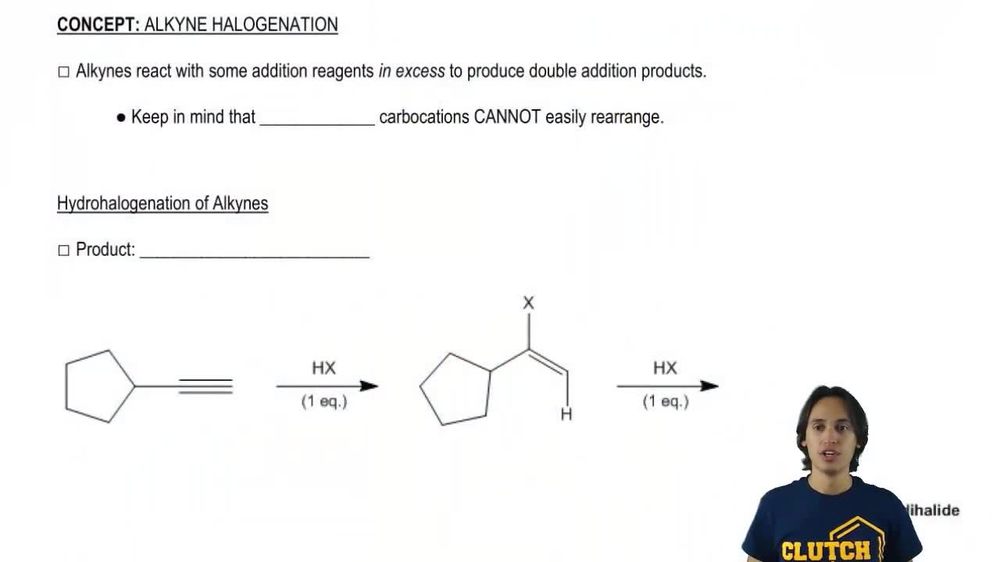
General properties of double addition reactions to alkynes.
Functional Group Transformations
Functional group transformations involve converting one functional group into another, which is a key strategy in organic synthesis. By understanding how to perform these transformations, such as converting alkynes to alcohols or ketones, chemists can design synthetic routes to create complex molecules from simpler starting materials like ethyne.