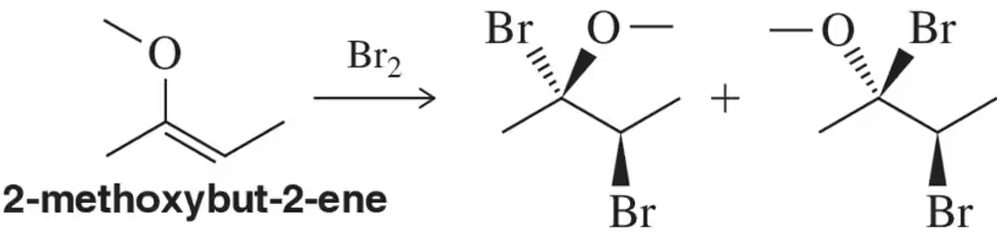
Bromination of a highly electron-rich alkene such as 2-methoxybut-2-ene has been shown to produce approximately equal mixtures of the trans- and cis-dibromide. Suggest an explanation for this observation.
Verified step by step guidance
1
Understand the reaction: Bromination of alkenes involves the addition of bromine (Br₂) across the double bond. This reaction typically proceeds via a three-step mechanism involving the formation of a bromonium ion intermediate.
Analyze the substrate: 2-methoxybut-2-ene is an electron-rich alkene due to the presence of the methoxy (-OCH₃) group, which donates electron density to the double bond through resonance and inductive effects. This increases the reactivity of the alkene toward electrophilic addition reactions like bromination.
Examine the mechanism: The first step involves the attack of the alkene on Br₂, forming a cyclic bromonium ion intermediate. This intermediate is highly strained and positively charged, making it susceptible to nucleophilic attack by the bromide ion (Br⁻).
Consider stereochemical outcomes: The bromide ion can attack the bromonium ion from either the top face or the bottom face of the planar intermediate. This leads to the formation of both trans- and cis-dibromides. The electron-rich nature of the alkene may reduce the preference for anti-addition (which typically dominates in bromination), allowing for the formation of both stereoisomers in approximately equal amounts.
Conclude the explanation: The equal mixture of trans- and cis-dibromides arises because the electron-rich nature of the alkene destabilizes the bromonium ion, reducing the stereochemical control of the reaction and allowing for nucleophilic attack from both faces of the intermediate with similar probabilities.
Verified video answer for a similar problem:
This video solution was recommended by our tutors as helpful for the problem above
Play a video:
0 Comments
Key Concepts
Here are the essential concepts you must grasp in order to answer the question correctly.
Electrophilic Addition Reactions
Electrophilic addition reactions involve the addition of an electrophile to a nucleophilic alkene. In the case of bromination, bromine acts as the electrophile, attacking the electron-rich double bond of the alkene. This reaction typically leads to the formation of a cyclic bromonium ion intermediate, which can then be attacked by a bromide ion from either side, resulting in different stereochemical outcomes.
Stereochemistry refers to the spatial arrangement of atoms in molecules and how this affects their chemical behavior. In the bromination of alkenes, the formation of both cis and trans dibromides occurs due to the planar nature of the bromonium ion intermediate, allowing for attack from either side. This leads to the formation of both stereoisomers, resulting in a mixture of products.
Regioselectivity and stereoselectivity are important concepts in organic reactions that describe how products are formed preferentially. In the bromination of 2-methoxybut-2-ene, the reaction is both regioselective and stereoselective, producing a mixture of cis and trans dibromides due to the symmetrical nature of the alkene and the lack of steric hindrance, allowing for equal formation of both isomers.

 Verified step by step guidance
 05:39
05:39