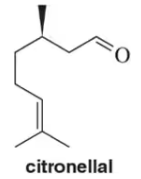
For the following terpenes, identify the isoprene units. In cross-linked or ring-containing terpenes, linkages can be formed between more than just C1 and C4 of isoprene. (a)
Verified step by step guidance
1
Step 1: Recall the structure of an isoprene unit, which consists of a five-carbon chain with two double bonds (C5H8). The carbons are numbered as follows: C1 and C4 are the terminal carbons, and C2, C3, and C5 are internal carbons.
Step 2: Analyze the structure of citronellal provided in the image. Citronellal is a monoterpene, meaning it is composed of two isoprene units (C10H16). Look for repeating patterns of five-carbon units within the molecule.
Step 3: Identify the first isoprene unit. In citronellal, the first isoprene unit can be traced starting from the methyl group (CH3) attached to the double bond and extending to the adjacent carbons, including the double bond itself.
Step 4: Identify the second isoprene unit. The second isoprene unit begins at the carbon connected to the aldehyde group (CHO) and extends through the chain, including the branching methyl group and the remaining carbons.
Step 5: Note that the linkage between the two isoprene units in citronellal is not a simple C1-C4 connection. Instead, the molecule exhibits a more complex arrangement due to the presence of branching and functional groups, which is common in terpenes with cross-linked or ring-containing structures.
Verified video answer for a similar problem:
This video solution was recommended by our tutors as helpful for the problem above
Play a video:
0 Comments
Key Concepts
Here are the essential concepts you must grasp in order to answer the question correctly.
Isoprene Unit
Isoprene units are the fundamental building blocks of terpenes, consisting of a five-carbon structure with the formula C5H8. Terpenes are formed by the polymerization of isoprene units, which can be linked in various ways to create diverse structures. Understanding how these units combine is essential for identifying the structure and classification of terpenes.
Terpenes are a large class of organic compounds produced by many plants, characterized by their strong odors and roles in plant defense. They can be linear or cyclic, and their structures can vary significantly based on how the isoprene units are arranged and linked. Recognizing the structural variations helps in identifying specific terpenes and their properties.
Cross-linking in terpenes refers to the formation of bonds between different isoprene units beyond the typical C1 and C4 positions. This can lead to complex structures such as rings or branched chains, which significantly influence the chemical properties and biological functions of the terpenes. Understanding cross-linking is crucial for analyzing the structure of terpenes like citronellal.