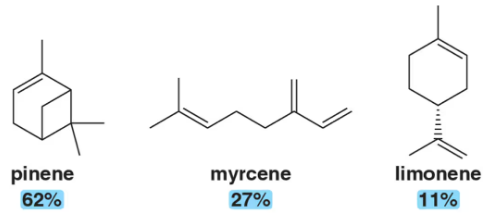
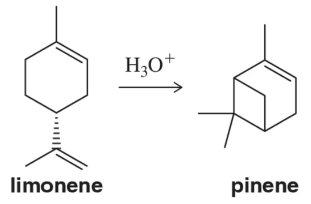
North American termite soldiers, when encountering enemy insects, contract their mandibular muscles, expelling a mixture of chemicals that essentially trap their enemies in a glue-like substance. This weapon, built into the face of the termite, is called the fontanellar gun. It releases a mixture of pinene (62%), myrcene (27%), and limonene (11%). (b) Suggest an acid-catalyzed mechanism by which pinene could be produced from limonene.
Verified step by step guidance
1
Step 1: Recognize that the transformation involves an acid-catalyzed reaction. The presence of H₃O⁺ indicates that protonation will play a key role in the mechanism.
Step 2: Protonate the double bond in limonene. The π-electrons of the double bond will attack the proton (H⁺), forming a carbocation intermediate. This step increases the electrophilicity of the molecule.
Step 3: Consider the stability of the carbocation intermediate. The carbocation formed will undergo rearrangement if necessary to achieve a more stable tertiary carbocation. This rearrangement is facilitated by the cyclic structure of limonene.
Step 4: Once the carbocation is stabilized, a cyclization reaction occurs. The carbocation interacts with another double bond in the molecule, forming the bicyclic structure characteristic of pinene.
Step 5: Deprotonation occurs to restore neutrality, completing the formation of pinene. The acid catalyst (H₃O⁺) is regenerated in this step, allowing the reaction to proceed catalytically.
Verified video answer for a similar problem:
This video solution was recommended by our tutors as helpful for the problem above
Play a video:
0 Comments
Key Concepts
Here are the essential concepts you must grasp in order to answer the question correctly.
Acid-Catalyzed Reactions
Acid-catalyzed reactions involve the use of an acid to increase the rate of a chemical reaction. In organic chemistry, acids can protonate reactants, making them more electrophilic and facilitating nucleophilic attacks. This mechanism is crucial for transformations such as rearrangements and eliminations, which are often seen in the conversion of one hydrocarbon to another, like limonene to pinene.
Isomerization is a process where a molecule is transformed into one of its isomers, which have the same molecular formula but different structural arrangements. In the context of organic compounds like limonene and pinene, isomerization can involve the rearrangement of double bonds or the shifting of functional groups, leading to different chemical properties and reactivity. Understanding this concept is essential for predicting the products of acid-catalyzed reactions.
Terpenes are a large class of organic compounds, often characterized by their strong odors and derived from plants. They are built from isoprene units and can undergo various reactions, including cyclization and rearrangement. The specific structures of terpenes like pinene, myrcene, and limonene influence their reactivity and the types of reactions they can undergo, making it important to analyze their structures when proposing mechanisms for their interconversion.