Ch. 20 - The Organic Chemistry of Carbohydrates
Bruice - Organic Chemistry 8th Edition
Bruice8th EditionOrganic ChemistryISBN: 9780135213711Not the one you use?Change textbook
Chapter 21, Problem 43

Propose a mechanism for the formation of d-allose from d-glucose in a basic solution.

Verified step by step guidance
1
Identify the structural difference between D-glucose and D-allose. D-glucose is an aldohexose with the hydroxyl group on carbon 3 (C3) pointing to the left in a Fischer projection, while in D-allose, the hydroxyl group on C3 points to the right. This indicates that the reaction involves an epimerization at C3.
Understand the role of the basic solution. In a basic environment, the alpha-hydrogen on the carbon adjacent to the carbonyl group (C2 in this case) is slightly acidic and can be deprotonated by the base, forming an enolate ion.
Propose the first step of the mechanism: Deprotonation. The base abstracts the alpha-hydrogen from C2 of D-glucose, forming an enolate intermediate. Represent this step using the enolate structure: CH22=CH-OH.
Propose the second step of the mechanism: Reprotonation. The enolate intermediate can be reprotonated at the C3 position from either side, leading to the formation of two possible epimers: D-glucose (if the hydroxyl group is re-added to the left) or D-allose (if the hydroxyl group is re-added to the right).
Conclude the mechanism: The equilibrium between the enolate intermediate and the two epimers allows for the interconversion of D-glucose and D-allose. In the presence of a base, this process is reversible, and the reaction mixture will contain both epimers.

Verified video answer for a similar problem:

This video solution was recommended by our tutors as helpful for the problem above.
Video duration:
5m
Was this helpful?

Key Concepts

Here are the essential concepts you must grasp in order to answer the question correctly.

Epimerization

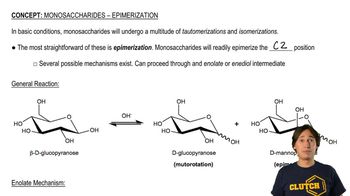
Epimerization is a specific type of stereoisomerism where two sugars differ in configuration at only one specific carbon atom. In the case of d-allose and d-glucose, they are epimers at the C-2 position. Understanding this concept is crucial for proposing a mechanism that involves the conversion of one sugar to another through the alteration of stereochemistry.
Recommended video:
Guided course
02:57
General Reaction

Basic Conditions

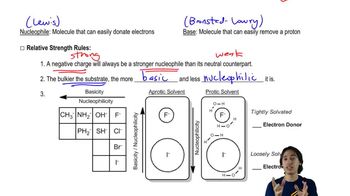
Basic conditions refer to an environment where the pH is greater than 7, often involving hydroxide ions (OH-). In organic reactions, basic conditions can facilitate deprotonation and nucleophilic attacks, which are essential for rearranging molecular structures. Recognizing how these conditions influence reaction pathways is vital for understanding the mechanism of d-allose formation from d-glucose.
Recommended video:
Guided course
06:21
Understanding the difference between basicity and nucleophilicity.

Nucleophilic Attack

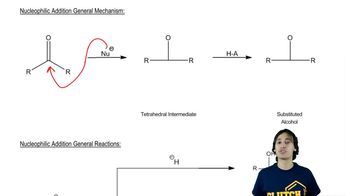
Nucleophilic attack is a fundamental reaction mechanism in organic chemistry where a nucleophile donates an electron pair to an electrophile, forming a chemical bond. In the context of sugar interconversion, nucleophilic attack can lead to the opening of the sugar's ring structure, allowing for the rearrangement of functional groups. This concept is key to understanding how d-glucose can be transformed into d-allose through a series of reaction steps.
Recommended video:
Guided course
08:27
Nucleophilic Addition