e. Which has a greater Ka: cyclohexanol or phenol? f. Which is a stronger acid: cyclohexanol or phenol?
Verified step by step guidance
1
Step 1: Understand the concept of Ka and acid strength. Ka, the acid dissociation constant, measures the extent to which an acid dissociates in water. A higher Ka value indicates a stronger acid because it dissociates more readily to release H⁺ ions.
Step 2: Analyze the chemical structures of cyclohexanol and phenol. Cyclohexanol is an alcohol with a hydroxyl group (-OH) attached to a cyclohexane ring, while phenol has a hydroxyl group attached to a benzene ring.
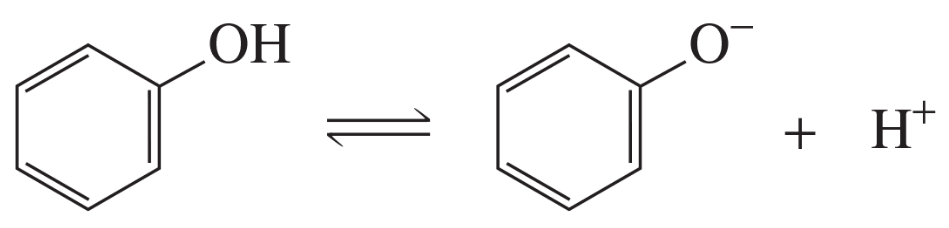
Step 3: Consider the resonance stabilization of the conjugate base. Phenol's conjugate base (phenoxide ion) is stabilized by resonance because the negative charge on the oxygen can delocalize into the aromatic ring. Cyclohexanol's conjugate base lacks this resonance stabilization, making it less stable.
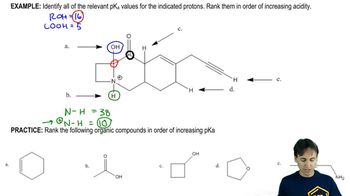
Step 4: Compare the Ka values. From the image, cyclohexanol has a Ka of 1 × 10⁻¹⁶, which is extremely small, indicating it is a very weak acid. Phenol, although its Ka is not explicitly provided in the image, is known to have a significantly higher Ka due to the resonance stabilization of its conjugate base.
Step 5: Conclude the comparison. Phenol has a greater Ka and is a stronger acid than cyclohexanol because its conjugate base is stabilized by resonance, allowing it to dissociate more readily in water.
Verified video answer for a similar problem:
This video solution was recommended by our tutors as helpful for the problem above
Video duration:
5m
Play a video:
0 Comments
Key Concepts
Here are the essential concepts you must grasp in order to answer the question correctly.
Acidity and pKa
Acidity in organic chemistry is often measured by the acid dissociation constant (Ka), which quantifies the strength of an acid in solution. A higher Ka value indicates a stronger acid, meaning it dissociates more completely in water. The pKa, which is the negative logarithm of Ka, is commonly used to compare acid strengths; lower pKa values correspond to stronger acids.
Resonance stabilization occurs when a molecule can be represented by multiple valid Lewis structures, allowing for the delocalization of electrons. In the case of phenol, the negative charge on the phenoxide ion (the conjugate base) can be delocalized over the aromatic ring, enhancing its stability compared to cyclohexanol, which lacks such resonance stabilization.
To determine which compound is a stronger acid, one must compare their ability to donate protons (H+). Phenol is generally a stronger acid than cyclohexanol due to the resonance stabilization of its conjugate base, phenoxide. This stabilization lowers the energy of the conjugate base, making it more favorable for phenol to lose a proton compared to cyclohexanol.