Show that the [4 + 4] cycloaddition of two butadiene molecules to give cycloocta-1,5-diene is thermally forbidden but photochemically allowed.
Verified step by step guidance
1
Step 1: Recall the Woodward-Hoffmann rules for pericyclic reactions. These rules state that the symmetry of molecular orbitals determines whether a pericyclic reaction is thermally allowed or forbidden. Specifically, for cycloadditions, the reaction is governed by the conservation of orbital symmetry.
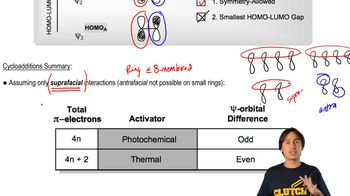
Step 2: Analyze the [4 + 4] cycloaddition. Each butadiene molecule contributes 4 π-electrons, so the total number of π-electrons involved in the reaction is 8. This makes it a π-electron system with 4n electrons, where n = 2.
Step 3: Apply the Woodward-Hoffmann rules for thermal reactions. For a thermal cycloaddition to be allowed, the reaction must proceed via a suprafacial-suprafacial interaction of the π-electrons. However, in a [4 + 4] cycloaddition, the symmetry of the molecular orbitals does not allow for a suprafacial-suprafacial interaction in the ground state. Therefore, the reaction is thermally forbidden.
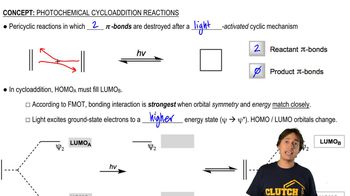
Step 4: Consider the photochemical conditions. Under photochemical conditions, one of the butadiene molecules is excited to a higher energy state, altering the symmetry of its molecular orbitals. This allows for a suprafacial-suprafacial interaction of the π-electrons, making the reaction photochemically allowed.
Step 5: Conclude that the [4 + 4] cycloaddition of two butadiene molecules to form cycloocta-1,5-diene is thermally forbidden due to orbital symmetry constraints but becomes allowed under photochemical conditions due to the altered orbital symmetry in the excited state.
Verified video answer for a similar problem:
This video solution was recommended by our tutors as helpful for the problem above
Video duration:
8m
Play a video:
0 Comments
Key Concepts
Here are the essential concepts you must grasp in order to answer the question correctly.
Cycloaddition Reactions
Cycloaddition reactions involve the joining of two or more unsaturated molecules to form a cyclic structure. In the case of [4 + 4] cycloaddition, two butadiene molecules combine to create cycloocta-1,5-diene. Understanding the mechanism and stereochemistry of these reactions is crucial for predicting their feasibility under different conditions.
The Woodward-Hoffmann rules provide a framework for predicting the outcomes of pericyclic reactions based on their symmetry properties. These rules indicate whether a reaction is allowed or forbidden under thermal or photochemical conditions. For the [4 + 4] cycloaddition, the rules suggest that the reaction is thermally forbidden due to symmetry considerations but can proceed when excited states are involved in photochemical conditions.
Thermal conditions refer to reactions occurring at standard temperatures, while photochemical conditions involve the absorption of light to promote reactions. In the context of cycloaddition, the energy provided by light can facilitate the reaction by allowing the system to overcome symmetry constraints that would otherwise render the reaction forbidden under thermal conditions.