
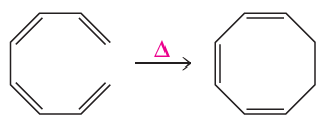
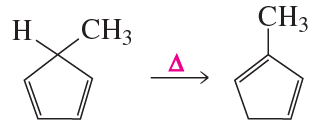

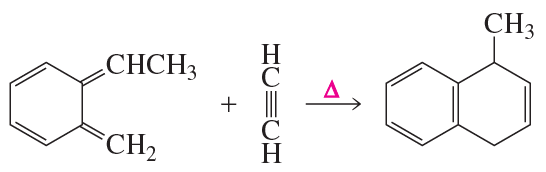
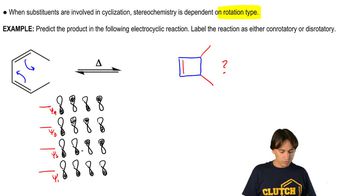
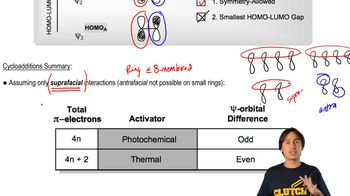
Examine the following pericyclic reactions. For each reaction, tell whether it is an electrocyclic reaction, a cycloaddition reaction, or a sigmatropic rearrangement. a. b. c. d.
Verified step by step guidance
1
Step 1: Understand the three types of pericyclic reactions. An electrocyclic reaction involves the opening or closing of a conjugated π-system to form a new σ-bond or break an existing one. A cycloaddition reaction involves the formation of a cyclic product by the combination of two π-systems. A sigmatropic rearrangement involves the migration of a σ-bond across a π-system, with the overall connectivity of the molecule remaining unchanged.
Step 2: Analyze reaction (a). Look for changes in the π-system and determine if a new σ-bond is formed (electrocyclic), if two π-systems combine to form a ring (cycloaddition), or if a σ-bond migrates across a π-system (sigmatropic rearrangement).
Step 3: Analyze reaction (b). Use the same criteria as in Step 2 to classify the reaction. Pay attention to the movement of electrons and the formation or breaking of bonds.
Step 4: Analyze reaction (c). Again, determine whether the reaction involves the opening/closing of a π-system (electrocyclic), the combination of two π-systems (cycloaddition), or the migration of a σ-bond (sigmatropic rearrangement).
Step 5: Analyze reaction (d). Follow the same process as in the previous steps to classify the reaction based on the changes in bonding and electron movement.
Verified video answer for a similar problem:
This video solution was recommended by our tutors as helpful for the problem above
Play a video:
0 Comments
Key Concepts
Here are the essential concepts you must grasp in order to answer the question correctly.
Pericyclic Reactions
Pericyclic reactions are a class of organic reactions that occur through a concerted mechanism, involving a cyclic transition state. These reactions typically involve the rearrangement of electrons in a way that conserves orbital symmetry, and they can be classified into three main types: electrocyclic reactions, cycloadditions, and sigmatropic rearrangements.
Electrocyclic reactions involve the conversion of a conjugated system into a cyclic structure through the breaking and forming of sigma bonds. These reactions are characterized by the movement of electrons in a way that can be influenced by heat or light, and they follow specific rules based on the number of π electrons involved, as described by the Woodward-Hoffmann rules.
Cycloaddition reactions are a type of pericyclic reaction where two or more unsaturated molecules or fragments combine to form a cyclic product. These reactions can be classified as [2+2] or [4+2] cycloadditions, depending on the number of π bonds involved. The stereochemistry and regioselectivity of these reactions are crucial for determining the structure of the final product.