
Under certain conditions, when (R)-2-bromobutane is heated with water, the SN1 substitution proceeds twice as fast as the SN2. Calculate the e.e. and the specific rotation expected for the product. The specific rotation of (R)-butan-2-ol is −13.5°. Assume that the SN1 gives equal amounts of the two enantiomers.
Verified step by step guidance
1
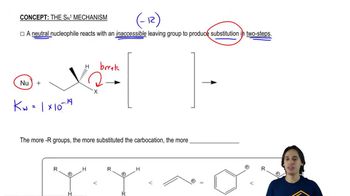
Step 1: Understand the reaction mechanism. The problem involves two substitution reactions: SN1 and SN2. SN1 proceeds via a carbocation intermediate and typically results in a racemic mixture due to the planar nature of the carbocation. SN2 proceeds via a backside attack, leading to inversion of configuration.
Step 2: Analyze the given data. The SN1 reaction produces equal amounts of the two enantiomers, meaning the product from SN1 is racemic and has no optical activity. The SN2 reaction produces only the (S)-enantiomer due to inversion of configuration.
Step 3: Determine the enantiomeric excess (e.e.). Enantiomeric excess is calculated using the formula: . Since SN1 proceeds twice as fast as SN2, the ratio of SN1 to SN2 products is 2:1.
Step 4: Calculate the specific rotation of the product. The specific rotation of a mixture is calculated using the formula: . Here, the specific rotation of (R)-butan-2-ol is given as −13.5°.
Step 5: Combine the results. Use the ratio of SN1 and SN2 products, the enantiomeric excess formula, and the specific rotation formula to calculate the e.e. and the specific rotation of the final product. Ensure to account for the racemic nature of the SN1 product and the optical activity of the SN2 product.
Verified video answer for a similar problem:
This video solution was recommended by our tutors as helpful for the problem above
Video duration:
5m
Play a video:
0 Comments
Key Concepts
Here are the essential concepts you must grasp in order to answer the question correctly.
SN1 and SN2 Mechanisms
SN1 and SN2 are two fundamental types of nucleophilic substitution reactions in organic chemistry. SN1 reactions involve a two-step mechanism where the leaving group departs first, forming a carbocation intermediate, followed by nucleophilic attack. In contrast, SN2 reactions occur in a single concerted step where the nucleophile attacks the substrate simultaneously as the leaving group departs. Understanding these mechanisms is crucial for predicting reaction rates and stereochemical outcomes.
Enantiomers are pairs of molecules that are non-superimposable mirror images of each other, often differing in their optical activity. Each enantiomer rotates plane-polarized light in opposite directions, measured as specific rotation. The concept of enantiomers is essential for calculating enantiomeric excess (e.e.), which quantifies the purity of one enantiomer over the other in a mixture, influencing the overall optical activity of the product.
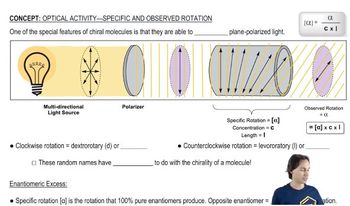
Specific rotation is a property of chiral compounds that quantifies their ability to rotate plane-polarized light, expressed as [α] = α / (c × l), where α is the observed rotation, c is the concentration in g/mL, and l is the path length in decimeters. In this context, calculating the specific rotation of the product involves considering the contributions from both enantiomers produced in the reaction, particularly when the SN1 mechanism yields equal amounts of each enantiomer.