
Textbook Question
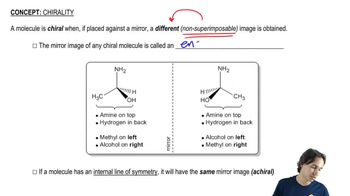
For each structure,
1. draw all the stereoisomers.
2. label each structure as chiral or achiral.
3. give the relationships between the stereoisomers (enantiomers, diastereomers).
(a)
2314
views

 Verified step by step guidance
 05:10
05:10
 05:43
05:43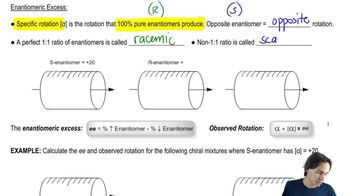 04:21
04:21For each structure,
1. draw all the stereoisomers.
2. label each structure as chiral or achiral.
3. give the relationships between the stereoisomers (enantiomers, diastereomers).
(a)
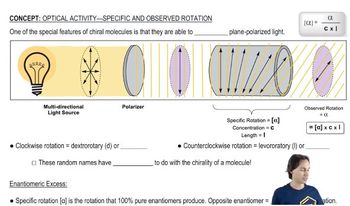
Calculate the specific rotations of the following samples taken at 25 °C using the sodium D line.
a. 1.00 g of sample is dissolved in 20.0 mL of ethanol. Then 5.00 mL of this solution is placed in a 20.0-cm polarimeter tube. The observed rotation is 1.25° counterclockwise.
(+)-Tartaric acid has a specific rotation Of +12.0°. Calculate the specific rotation of a mixture of 68% (+)-tartaric acid and 32% (–)-tartaric acid.
Calculate the specific rotations of the following samples taken at 25 °C using the sodium D line.
b. 0.050 g of sample is dissolved in 2.0 mL of ethanol, and this solution is placed in a 2.0-cm polarimeter tube. The observed rotation is clockwise 0.043°.
Free-radical bromination of the following compound introduces bromine primarily at the benzylic position next to the aromatic ring. If the reaction stops at the monobromination stage, two stereoisomers result.
d. What is the relationship between the two isomeric products?
e. Will these two products be produced in identical amounts? That is, will the product mixture be exactly 50:50?
f. Will these two stereoisomers have identical physical properties such as boiling point, melting point, solubility, etc.? Could they be separated (theoretically, at least) by distillation or recrystallization?
Free-radical bromination of the following compound introduces bromine primarily at the benzylic position next to the aromatic ring. If the reaction stops at the monobromination stage, two stereoisomers result.
a. Propose a mechanism to show why free-radical halogenation occurs almost exclusively at the benzylic position.
b. Draw the two stereoisomers that result from monobromination at the benzylic position.
c. Assign R and S configurations to the asymmetric carbon atoms in the products.