What hydrocarbon forms the following products after reaction first with ozone and then with dimethyl sulfide?
Verified step by step guidance
1
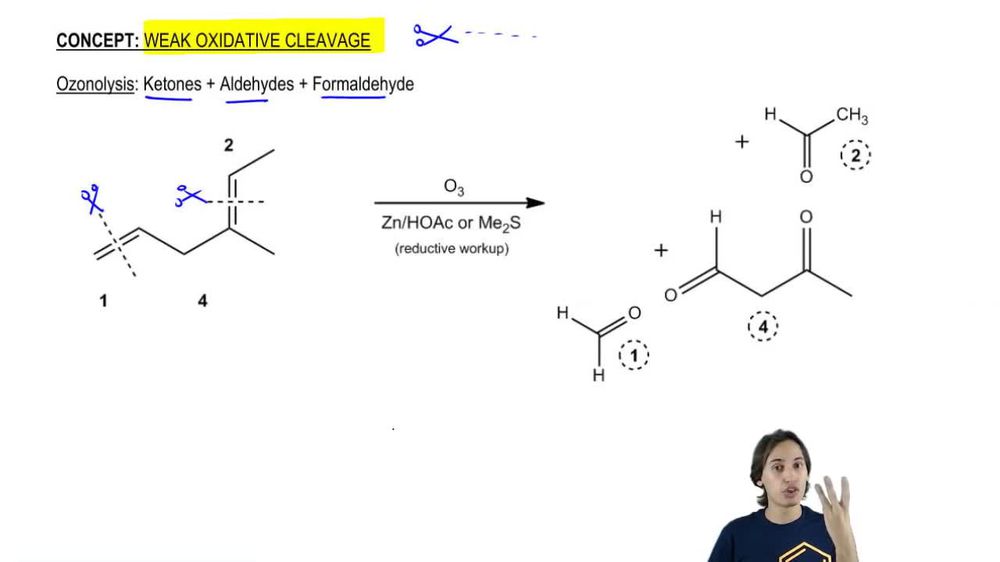
Step 1: Understand the reaction sequence. The problem involves ozonolysis, a reaction where ozone (O₃) cleaves the double bonds in alkenes to form carbonyl compounds. Dimethyl sulfide (DMS) is then used as a reducing agent to convert the ozonide intermediate into aldehydes or ketones.
Step 2: Identify the type of hydrocarbon that undergoes ozonolysis. Typically, alkenes (hydrocarbons with at least one C=C double bond) are the substrates for ozonolysis. The double bond is cleaved, and the carbon atoms involved in the double bond are converted into carbonyl groups.
Step 3: Predict the products formed after ozonolysis. The products depend on the structure of the alkene. For example, if the alkene is symmetrical, identical carbonyl compounds will be formed. If the alkene is asymmetrical, different carbonyl compounds will result.
Step 4: Use the given products to deduce the structure of the original hydrocarbon. Analyze the carbonyl compounds formed (aldehydes or ketones) to determine the positions of the double bond in the original alkene. The number and type of carbonyl compounds provide clues about the structure of the starting material.
Step 5: Confirm the hydrocarbon structure. Based on the products formed after ozonolysis and reduction with dimethyl sulfide, reconstruct the original alkene by placing the double bond in the correct position to match the observed products.
Verified video answer for a similar problem:
This video solution was recommended by our tutors as helpful for the problem above
Video duration:
5m
Play a video:
0 Comments
Key Concepts
Here are the essential concepts you must grasp in order to answer the question correctly.
Ozonolysis
Ozonolysis is a reaction involving the cleavage of carbon-carbon double bonds (alkenes) using ozone (O3). This reaction typically results in the formation of carbonyl compounds, such as aldehydes or ketones, depending on the structure of the starting alkene. The process involves the formation of a cyclic ozonide intermediate, which is subsequently reduced to yield the final products.
Dimethyl sulfide (DMS) is commonly used as a reducing agent in organic chemistry, particularly in the workup of ozonolysis reactions. After ozonolysis, the ozonide intermediate can be treated with DMS, which reduces the carbonyl compounds formed into their corresponding alcohols or further reduces them to hydrocarbons. This step is crucial for transforming the ozonolysis products into more stable or desired forms.
Understanding the structure of hydrocarbons is essential for predicting the products of reactions like ozonolysis. Hydrocarbons can be aliphatic (straight or branched chains) or aromatic (cyclic structures with delocalized electrons). The specific arrangement of carbon and hydrogen atoms influences how the molecule reacts with ozone and DMS, ultimately determining the nature of the products formed in the reaction sequence.

 5:17 minutes
 Verified step by step guidance
 06:30
06:30