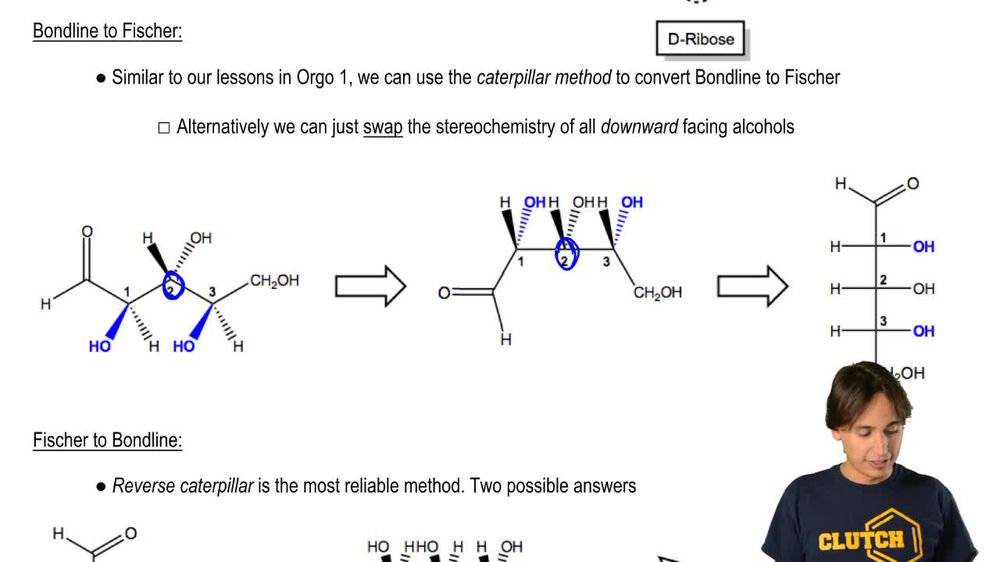
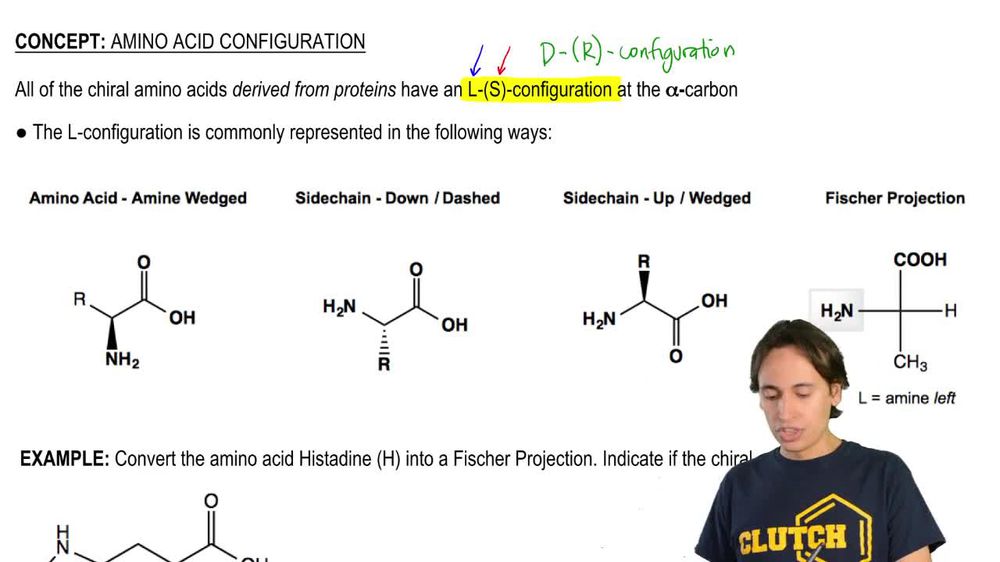
Which configuration (R or S) does the bottom asymmetric carbon have for the D series of sugars? Which configuration for the L series?
Verified step by step guidance
1
Step 1: Identify the bottom asymmetric carbon in both D-Glucose and L-Glucose. This is the carbon atom directly attached to the CH₂OH group.
Step 2: Assign priorities to the substituents attached to the bottom asymmetric carbon based on the Cahn-Ingold-Prelog priority rules. The substituents are: CH₂OH (highest priority), OH, H, and the rest of the chain.
Step 3: Determine the spatial arrangement of the substituents around the bottom asymmetric carbon for D-Glucose. Visualize or use a model to determine whether the configuration follows a clockwise (R) or counterclockwise (S) rotation.
Step 4: Repeat the process for L-Glucose. Note that the substituents on the bottom asymmetric carbon are mirrored compared to D-Glucose, which will affect the configuration.
Step 5: Conclude the configurations for both D-Glucose and L-Glucose based on the analysis. For D-Glucose, the bottom asymmetric carbon typically has an R configuration, while for L-Glucose, it has an S configuration.
Verified video answer for a similar problem:
This video solution was recommended by our tutors as helpful for the problem above
Video duration:
5m
Play a video:
0 Comments
Key Concepts
Here are the essential concepts you must grasp in order to answer the question correctly.
Chirality and Stereoisomers
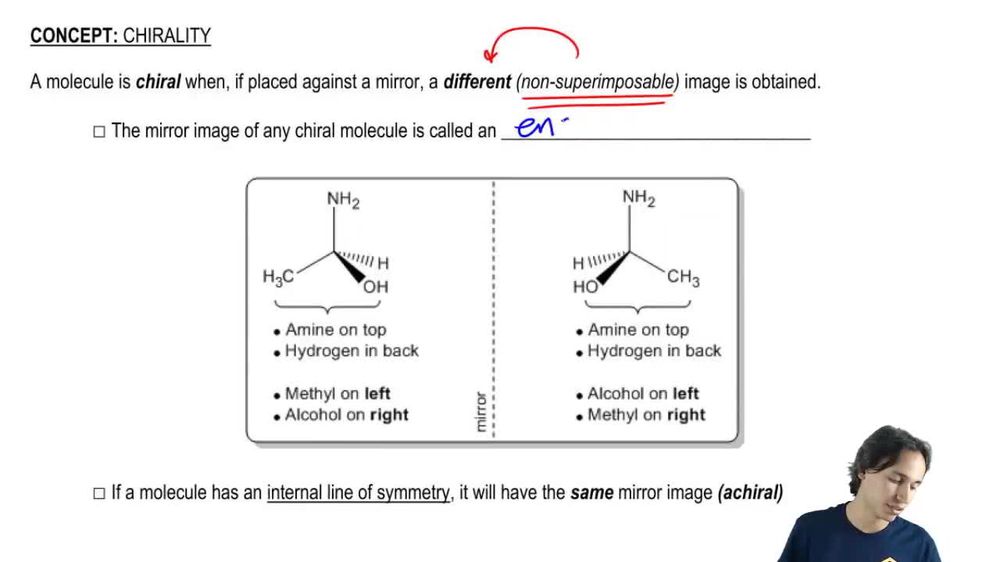
Chirality refers to the property of a molecule that makes it non-superimposable on its mirror image, leading to the existence of stereoisomers. In organic chemistry, chiral centers, typically carbon atoms with four different substituents, give rise to two configurations: R (rectus) and S (sinister). Understanding chirality is crucial for determining the specific configuration of sugars like D-Glucose and L-Glucose.
Fischer projections are a two-dimensional representation of three-dimensional organic molecules, particularly useful for depicting the stereochemistry of sugars. In these projections, vertical lines represent bonds going back into the plane, while horizontal lines represent bonds coming out. This format allows for easy identification of chiral centers and their configurations, essential for distinguishing between D and L forms of sugars.
The D and L notation for sugars is based on the orientation of the hydroxyl group (-OH) on the penultimate carbon (the second to last carbon) in the Fischer projection. If the -OH group is on the right side, the sugar is classified as D (from dexter, meaning right), while if it is on the left, it is classified as L (from laevus, meaning left). This classification is fundamental in carbohydrate chemistry and helps in understanding the biological roles of different sugar forms.

 5:37 minutes
 Verified step by step guidance
 05:10
05:10