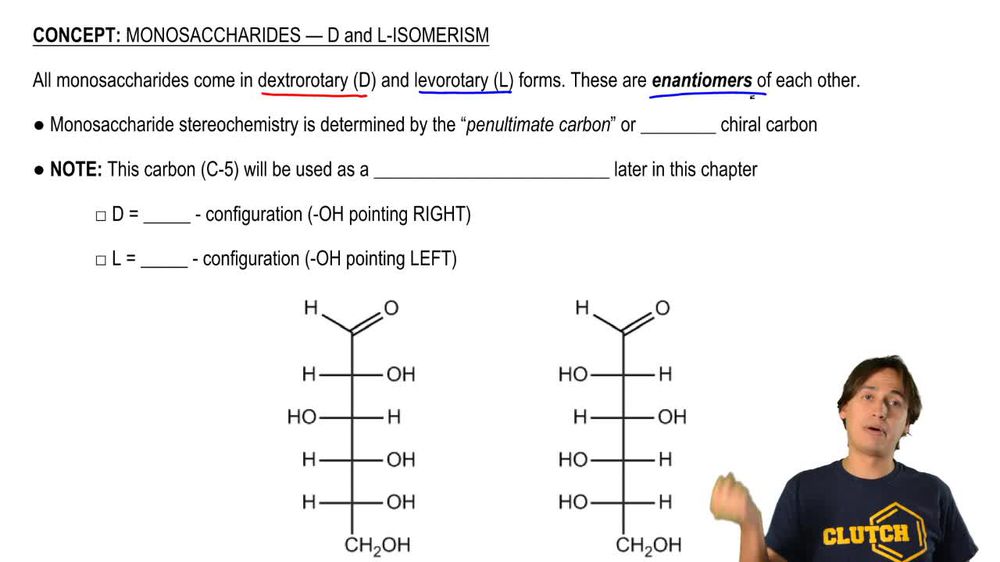
Which configuration (R or S) does the bottom asymmetric carbon have for the D series of sugars? Which configuration for the L series?
Verified step by step guidance
1
Identify the bottom asymmetric carbon in the Fischer projection of the sugar.
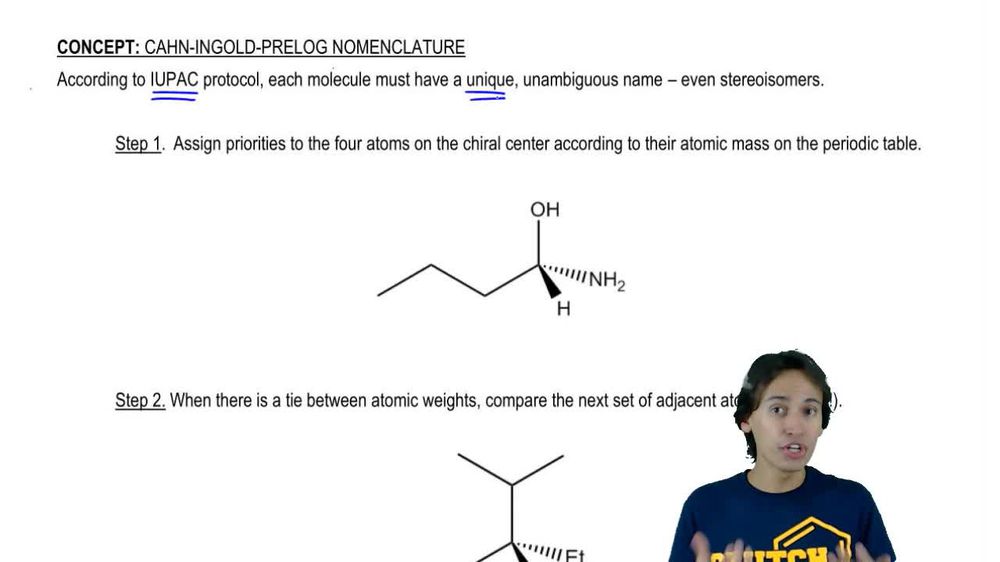
Assign priorities to the four substituents attached to the bottom asymmetric carbon based on the Cahn-Ingold-Prelog priority rules.
Orient the molecule so that the lowest priority group is pointing away from you.
Determine the order of the remaining three groups: if the sequence is clockwise, the configuration is R; if counterclockwise, it is S.
For D sugars, the bottom asymmetric carbon typically has the R configuration, while for L sugars, it typically has the S configuration.
Verified video answer for a similar problem:
This video solution was recommended by our tutors as helpful for the problem above
Video duration:
5m
Play a video:
0 Comments
Key Concepts
Here are the essential concepts you must grasp in order to answer the question correctly.
Chirality and Asymmetric Carbons
Chirality refers to the property of a molecule that makes it non-superimposable on its mirror image, often due to the presence of an asymmetric carbon atom. An asymmetric carbon is a carbon atom bonded to four different groups, leading to two possible configurations, known as enantiomers. Understanding chirality is crucial for determining the R or S configuration of sugars.
The Cahn-Ingold-Prelog (CIP) priority rules are a set of guidelines used to assign priorities to the substituents attached to an asymmetric carbon. According to these rules, the substituents are ranked based on atomic number, with higher atomic numbers receiving higher priority. This ranking is essential for determining whether the configuration is R (rectus, right) or S (sinister, left) when viewing the molecule from a specific orientation.
The D and L notation in sugars refers to the configuration of the asymmetric carbon farthest from the aldehyde or ketone group. In D sugars, this carbon has the same configuration as D-glyceraldehyde, while in L sugars, it has the opposite configuration. This distinction is important for understanding the stereochemistry of carbohydrates and their biological roles.

 5:37 minutes
 Verified step by step guidance
 05:41
05:41