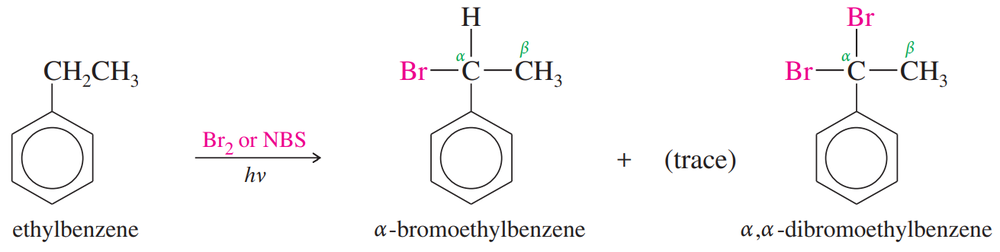
Propose a mechanism for the bromination of ethylbenzene shown below.
Verified step by step guidance
1
Step 1: Recognize that the reaction involves the bromination of ethylbenzene under photochemical conditions (hv). This indicates a free radical mechanism rather than an electrophilic aromatic substitution.
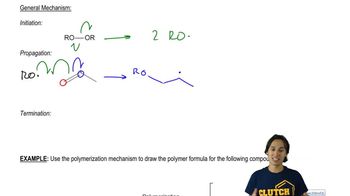
Step 2: Initiation: The bromine molecule (Br₂) absorbs light energy (hv), causing homolytic cleavage of the Br-Br bond to generate two bromine radicals. This can be represented as:
Step 3: Propagation (Step 1): A bromine radical abstracts a hydrogen atom from the benzylic position of ethylbenzene, forming a benzylic radical. The benzylic radical is stabilized due to resonance with the aromatic ring. This step can be represented as:
Step 4: Propagation (Step 2): The benzylic radical reacts with another bromine molecule (Br₂), forming the brominated product (1-bromoethylbenzene) and regenerating a bromine radical. This step can be represented as:
Step 5: Termination: The reaction can terminate when two radicals combine to form a stable molecule, such as two bromine radicals forming Br₂ or a benzylic radical combining with a bromine radical to form the product. However, termination steps are less common under controlled conditions with limited bromine.
Verified video answer for a similar problem:
This video solution was recommended by our tutors as helpful for the problem above
Video duration:
12m
Play a video:
0 Comments
Key Concepts
Here are the essential concepts you must grasp in order to answer the question correctly.
Electrophilic Aromatic Substitution
Electrophilic aromatic substitution (EAS) is a fundamental reaction in organic chemistry where an electrophile replaces a hydrogen atom on an aromatic ring. In the case of ethylbenzene, the bromine (Br2) acts as the electrophile, and the reaction typically involves the formation of a sigma complex, where the aromaticity is temporarily lost before the hydrogen is replaced by bromine.
The bromination of ethylbenzene under light (hv) suggests a radical mechanism, specifically a free radical halogenation. This process involves the generation of bromine radicals from Br2, which then abstract hydrogen atoms from ethylbenzene, leading to the formation of a brominated product. The reaction proceeds through initiation, propagation, and termination steps characteristic of radical reactions.
Regioselectivity refers to the preference of a chemical reaction to yield one structural isomer over others. In the bromination of ethylbenzene, the presence of the ethyl group, which is an electron-donating group, influences the regioselectivity, favoring substitution at the benzylic position (the carbon adjacent to the aromatic ring) over other positions, leading to the formation of 1-bromoethylbenzene.